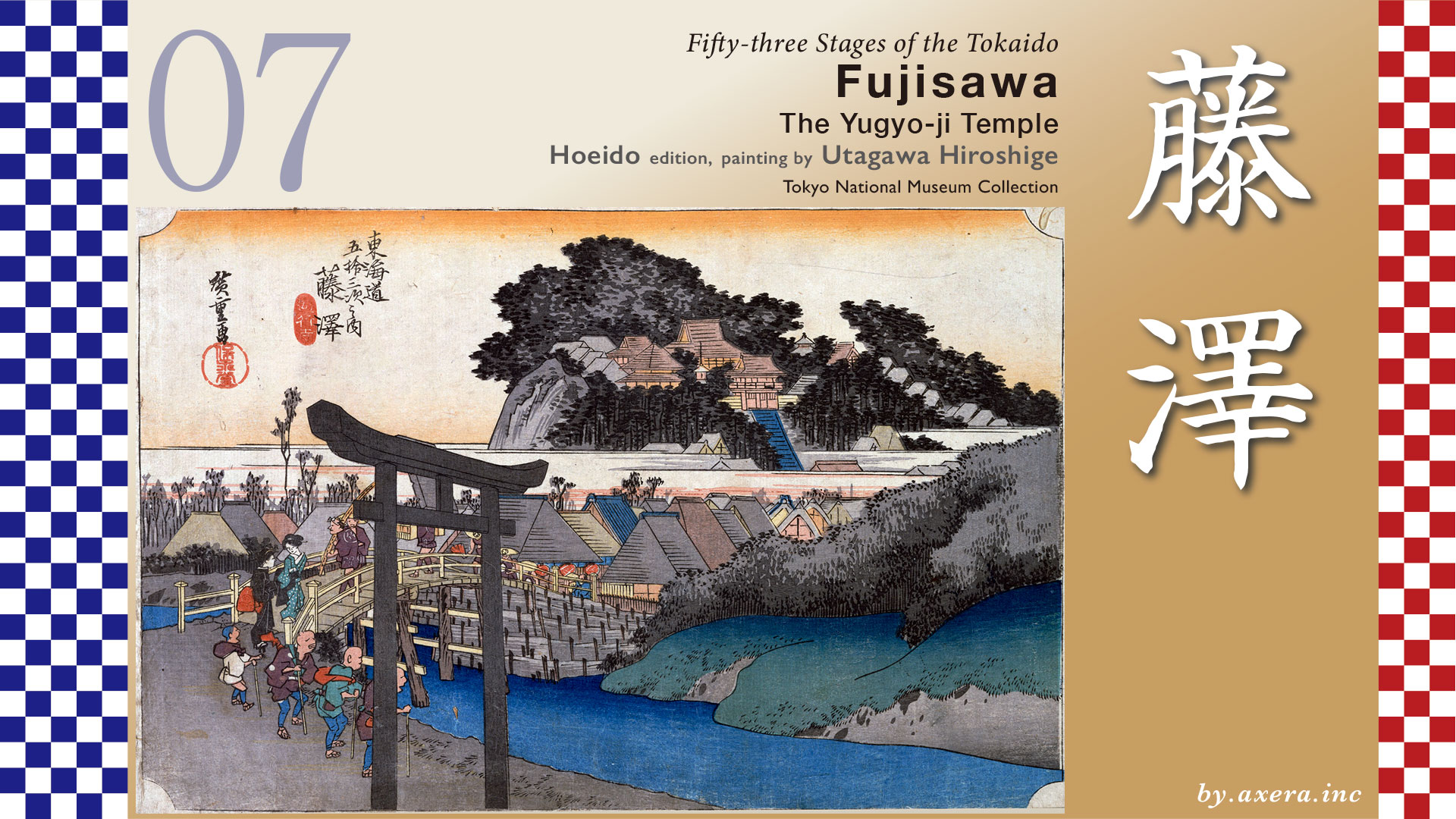
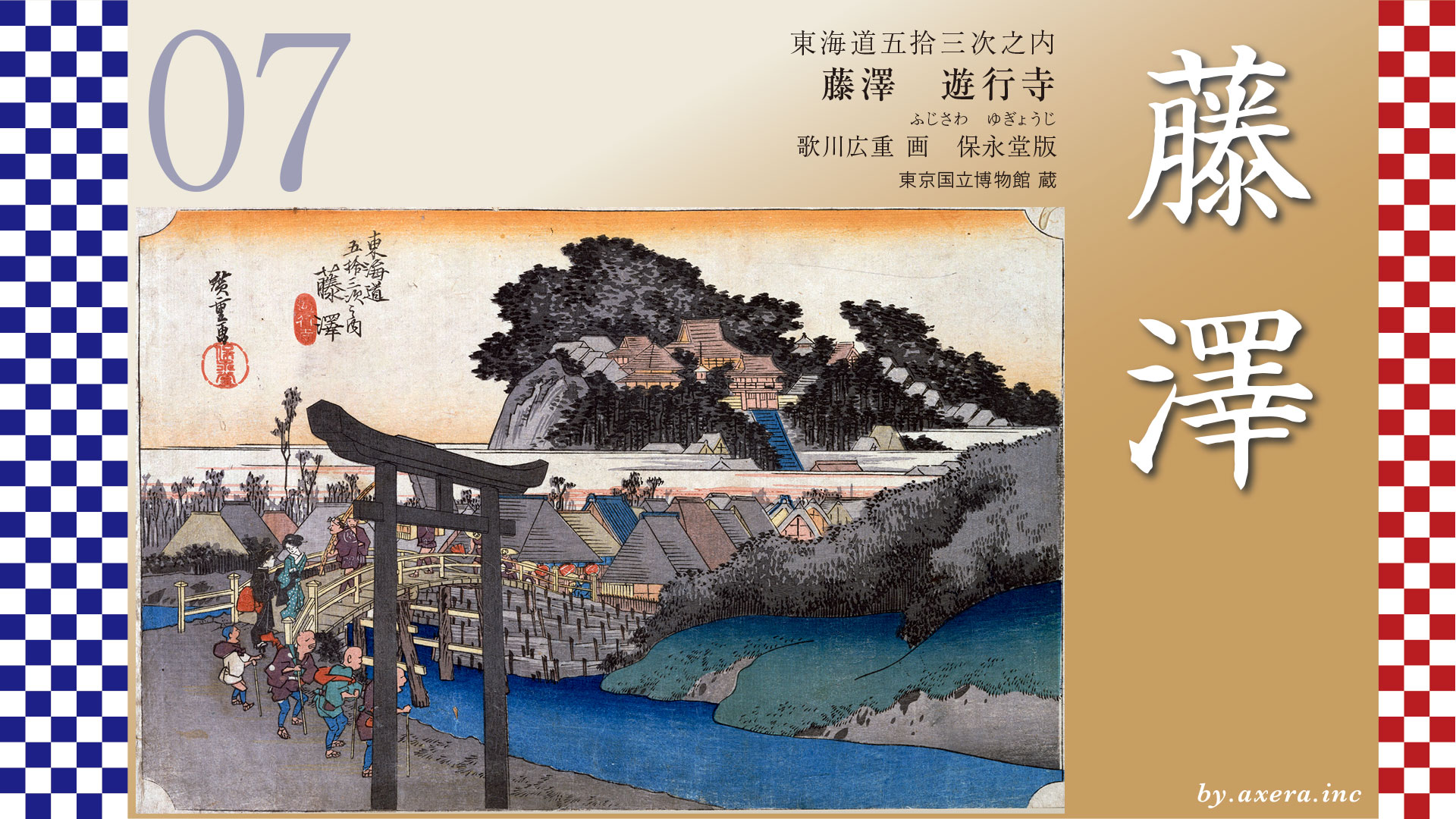
This painting shows the view looking back across the present-day Yougyoji Bridge, turning left onto Enoshima Michi, and looking up at Yougyo-ji Temple.
From Totsuka-juku, it is about 7.3 km to Fujisawa-juku, crossing a steep hill called “Oosaka” on the way. From around Gumiizawa, the route joins the current Route 1 and follows the same course as the Hakone Ekiden at New Year’s.
In the Harajuku area, which was an inn during that period, the road was widened and the Harajuku intersection, which was a famous traffic congestion spot, was made multi-level.
After crossing Kagetori, where a pond is said to have once been inhabited by a serpent that eats shadows, the road splits in two and enters the Tokaido, which is a little narrower.
Please see the enlarged map. The Tokaido begins its full-scale descent just before Yugyo-ji Temple, and is a major showcase for the Hakone Ekiden held during the New Year’s holiday season.
On the Ekiden, you cross the Fujisawa Bridge straight ahead, but on the Tokaido, you turn right onto a road with no traffic lights or anything, and cross the Yougyoji Bridge with your back to the gate of Yougyo-ji Temple. At the end of the road, go right on Tokaido and left on Enoshima-do.
To the west is the center of Fujisawa-juku. Fujisawa-juku, the sixth stop on the Tokaido, prospered as the gate town of Yugyo-ji Temple even before the Tokaido was established, and by the end of the Edo period there were reportedly more than 70 inns in the area.
The Honjin was also a branch of the Hachioji michi, which crossed the Hikichi River and went further west to the north of the present Tsujido Station, where it branched off with the Oyama michi.
Let’s take a look at Hiroshige’s painting.
This black torii gate is the first torii gate of Enoshima Benzaiten Shrine, and if you pass through this gate and go to the right, you will reach Enoshima Island after about 4 km on the Enoshima Michi. Enoshima Benzaiten Shrine was visited by many priests during the Edo period, due to the influence of the
highest-ranking blind court official, Waichi Sugiyama, who was a great admirer of Enoshima Benzaiten Shrine.
The bridge in blue is the Sakai River flowing from Machida, and the bridge over it is the Yougyoji Bridge, which was called the Dai-giri Bridge at that time. Two women are crossing the bridge to go to Yougyo-ji Temple, and a group of people with wooden swords on their backs is coming across from the other side of the bridge. This group is a group of people from the Oyama Kou, there is a group of people who are on their way to a pilgrimage to Mt.Oyama.
The long blue staircase at the top of the misty clouds is Yougyo-ji Temple.
The Reisho edition depicts the torii gate and the Yougyoji bridge from the west direction. The area across the Yougyoji Bridge is like a small plaza with the torii gate at its center, which conveys the bustling atmosphere of Fujisawa-juku. Under the torii gate, a road sign with a lantern is also visible.
The Gyosho edition depicts the bridge and torii gate, but a simple stone signpost can be seen at the corner of Enoshima Michi, and a flat plaque of Enoshima Benzaiten Shrine hangs on the torii gate. The Oyama Ko group is now crossing the Yugyoji Bridge to return home.
The Poem edition is a view of the bridge and torii gate from the Yugyo-ji side. If you go left at the torii gate and the willow tree through which the palanquin bearer is passing, you will reach Enoshima. If you go to the right between houses, you will be on Tokaido, heading for the Honjin at Fujisawa-juku.
To see the location of the roads, I reproduced the relationship between the Tokaido and Enoshima Michi at that time in orange on GoogleMAP’s Street View.
I added Hiroshige’s viewpoint and the torii gate in red gradation. The Tokaido coming from the right crosses the Yugyoji Bridge, passes through the torii gate, and comes to this side of the road, which is the Enoshima Michi, and goes to the other side without passing through the bridge and turns left, which is the Fujisawa-juku honjin. This shows that, from Hiroshige’s point of view, it is a bit impossible to include Yugyo-ji Temple in the same picture.
Returning to the painting, it appears as if the artist used haze clouds in front of the temple to adjust the direction of the image. In any case, if he was going to depict Fujisawa, he could not leave out Yugyo-ji Temple, which was famous at the time as the fundamental Buddhist center of the Yugyo buddhist invocation sect. In any case, if Hiroshige were to depict Fujisawa, he could not have left out Yugyo-ji Temple, which was famous at the time as the fundamental center of Buddhist practice.
Here is a picture of the actual place. There is no torii gate, but the stone pillar for the Enoshima Michi guide is still there. The Yougyoji Bridge is slightly visible behind the white building in the middle, but it is made of red iron. At that time, there was a torii gate in front of this white building.
If you look at Yougyoji Temple from the same vantage point, you will see that it faces quite a bit to the right. The slight reddish color on the left is the Yougyo-ji Bridge.
This is the gate of Yougyo-ji Temple seen with the bridge in the background. It is a simple wooden gate surrounded by a tsuiji wall. The official name of the temple is Fujisawa Muryōkōin Shokojoji, and it was built by Ippen Shōnin, the founder of the Jishū sect of Zen Buddhism. It is the head temple of the 274 temples of the Jishu sect, although it was founded by Priest Donkai, the fourth generation of the sect, counting from Ippen Shonin, the founder of the Jishu sect. It is a historic temple founded in 1325, with a statue of Amida Nyorai as its principal image that leads ordinary people to the Pure Land of Ultimate Bliss.
This is a bird’s-eye view of Yugyo-ji Temple drawn in Tokaido Meisho Zue. It is said that Hiroshige used this painting as a reference.
This is Enoshima Island, 4 km away from the torii gate in Hiroshige’s painting. At that time, it was an ancient training ground surrounded by cliffs and a short distance from the shore, but now it is the most popular sightseeing spot in Kanagawa.
Enoshima Benzaiten Shrine is the patron god of Kabuki and other vocations related to music. In particular, Sugiyama Kengyo received the acupuncture technique called kudabari, in which acupuncture needles are inserted through a tube, from a prayer to Benzaiten. This skill earned him the great trust of Shogun Tsunayoshi, and Sugiyama became the “Soroku Kengyo,” or the highest-ranking blind court official in the eight provinces of the Kanto region. It is said that the 12 road signs that remain in Fujisawa today were erected by Sugiyama Kengyō so that even the blind could understand them.
For this reason, it is said that all the priests of the Edo period were aiming for Enoshima Benzaiten Shrine.Enoshima Benzaiten Shrine was depicted in ukiyoe woodblock prints, was the setting for kabuki plays, and was a very famous sightseeing spot during the Edo period. This painting by Hiroshige depicts the bustle of Benzaiten’s opening in a triptych.
.
This is Mt. Oyama as seen from Isehara area. Oyama has been a mountain of mountain worship since ancient times and was famous as a place to pray for rain. During the Edo period, the mountain became very popular among craftsmen and steeplejacks, and “Oyama-ko” were formed in various parts of Edo.
.
As in the rakugo story “Oyama Pilgrimage,” there was an established sightseeing route that always included stops at Enoshima, Kamakura, and Kanazawa after the pilgrimage to allowing oneself meat. This painting by Katsushika Hokusai depicts the famous waterfall on the way to Oyama Pilgrimage. Here, too, the people in the group are holding wooden swords.
Katsushika Hokusai also made a sightseeing Sugoroku that toured Kamakura, Enoshima, and Oyama. Starting from Nihonbashi, there are 42 fun-looking pictures in a row. It is clear that this area was quite a famous sightseeing spot at that time. Sugoroku is traditional Japanese board game played with dice.
GoogleMAP Street View shows a view of this destination from above the Yougyo-ji Temple.
Hiroshige may have considered this Fujisawa as a place where religions intersected. In the Edo period, when information was scarce, it is amazing that Edo commoners relied on non-human forces for their clinging feelings and sublimated them into the enjoyment of travel. Of course, although they are not depicted in the paintings, there must have been many travelers on the Tokaido who made pilgrimages to Ise and Akiba.
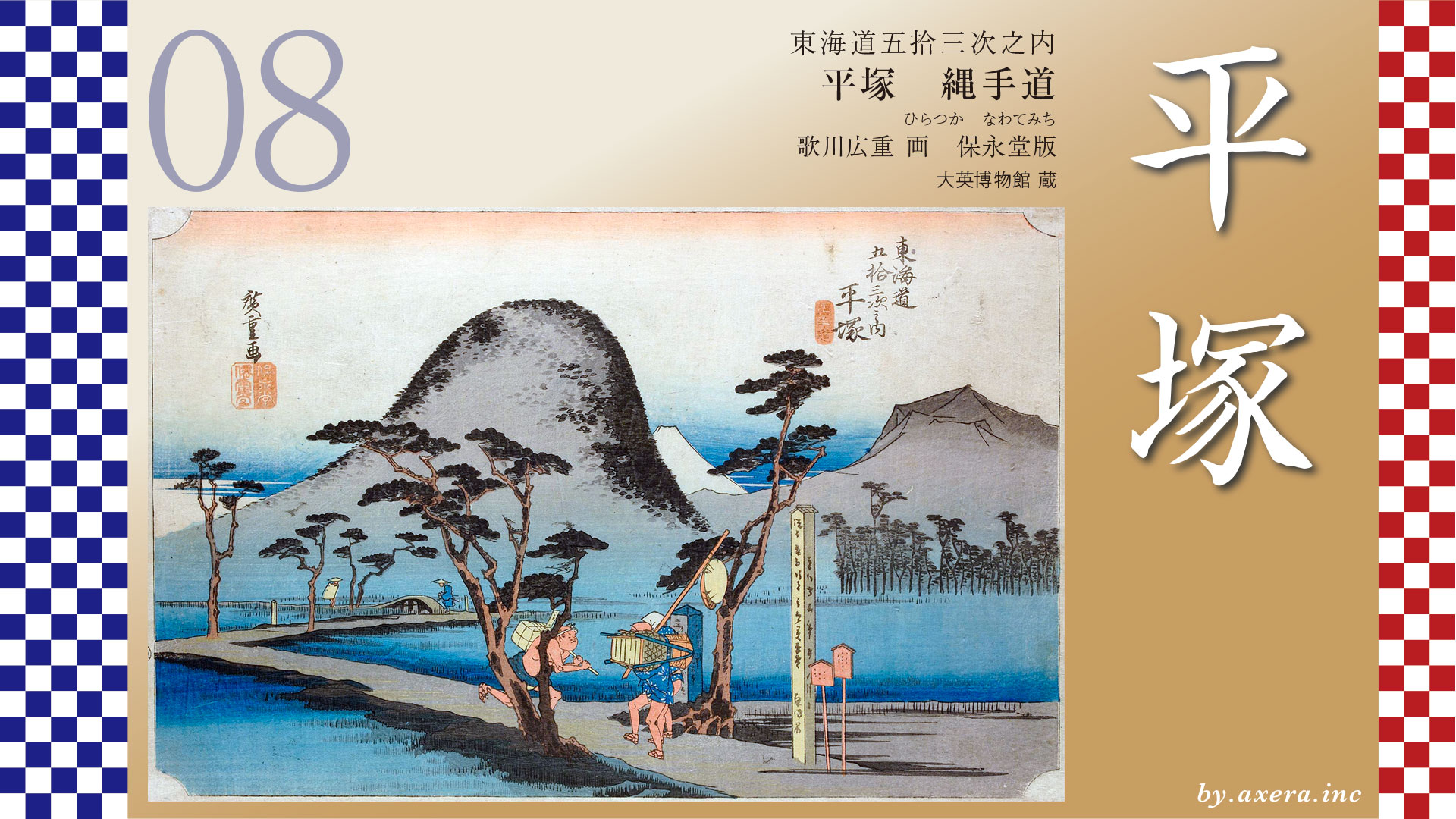
From Fujisawa-juku, the Tokaido crosses the Odakyu Line and heads almost due west toward Hiratsuka-juku. Fuji came into view far ahead.
コメント