
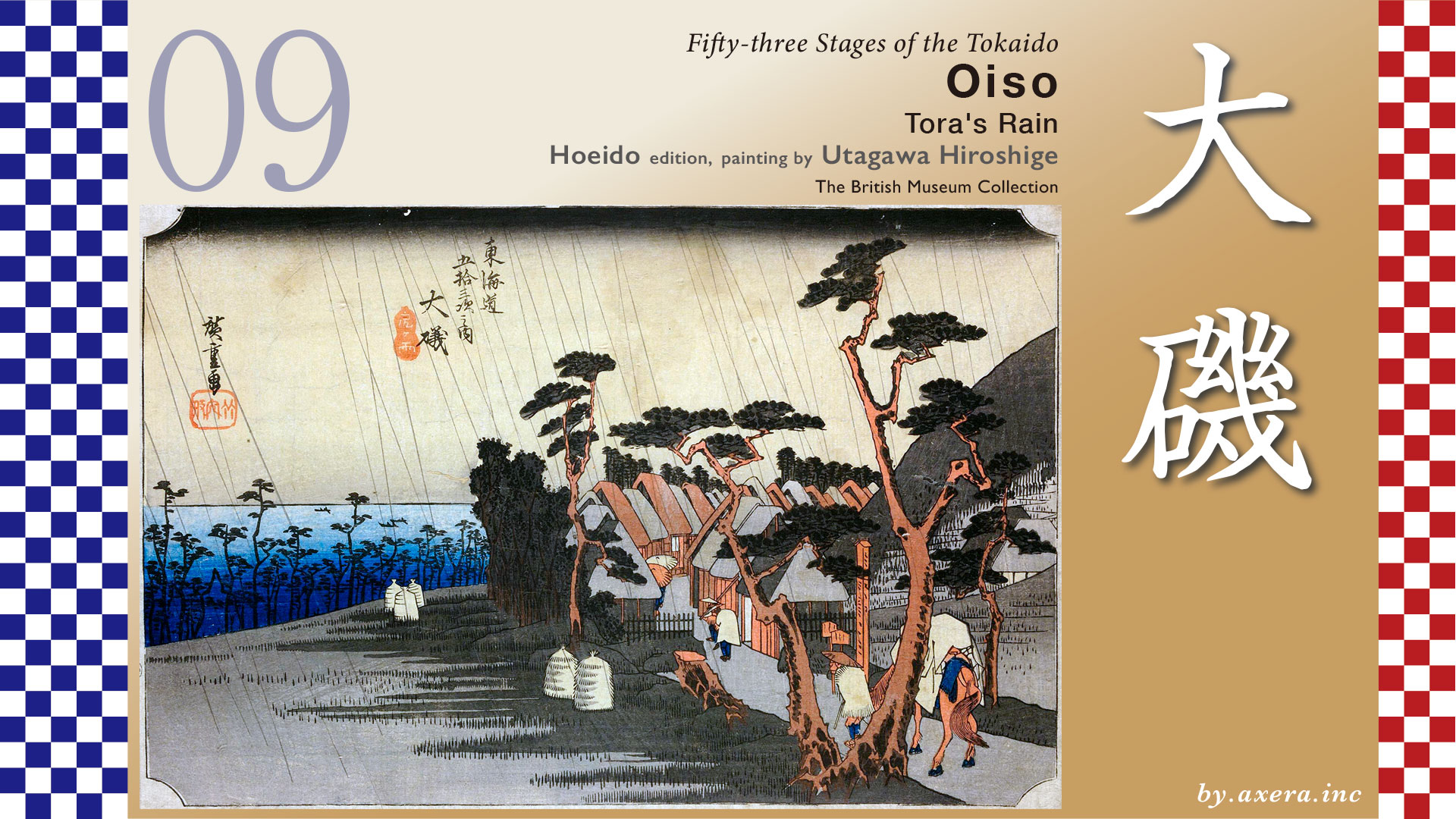
This painting depicts a row of houses and the ocean in the rain just as they enter the Oiso-juku.
The distance from Hiratsuka-juku to Oiso-juku was only less than 3 km, a distance that could be quickly reached by any traveler with the leg strength of the time.
After passing Hanamizu Bridge, continue on, and at the Kewaizaka traffic light, the road splits off from Route 1 and goes up a small path on the right. As soon as you enter the path, you will see the well of Tora Gozen, which is the origin of the name “Kewaizaka” (Make-up Slope).
Entering the Kewaizaka slope, beautiful pine trees line the street, and at the top of the slope, passing under the railroad tracks, is the Edo-mitsuke of Oiso-juku, where Hiroshige seems to have painted a rainy scene of this area.
The Tokaido then merges with Route 1, and after passing in front of Oiso Station, it makes a sharp right turn around a kamaboko store and passes through a traffic light at Shigitatsusawa. Shigitatsu-an is on the left of this traffic light. Further up the hill, around Oiso Junior High School, the road splits in two and a row of magnificent pine trees appears. The Tokaido, as one might expect, is the main road that runs through this area.
First, please take a look at a few of Hiroshige’s paintings here. The scene of softly pouring rain seems somewhat dark and sad, but it is related to an anecdote about the Soga brothers. Hiroshige depicted the brothers’ life story in 30 paintings as “Soga Monogatari Zue”. Please see some of them and Ukiyoe of the Utagawa group.
The story begins with a dispute between Kudo Suketsune and the grandfather of the Soga brothers over the territory of Izu. During this conflict, the father of the Soga brothers was killed by Kudo Suketsune. His wife remarried with their two young children to Soga Sukenobu of Sagami Province. Four years later, at the age of 9 and 7, the elder brother and younger brother made a firm vow to one day avenge Kudo Suketsune.
Meanwhile, “Tora,” the daughter of the chief of Oiso, who was naturally beautiful and clever, fell in love at the age of 17 with 20-year-old Soga Juro Sukenari, the older brother of the Soga brothers, who wanted to avenge their father’s death. Two years later, the brothers successfully defeated their father’s avenger, Kudo Suketsune, during a hunt organized by Minamoto no Yoritomo at the foot of Mt. Fuji. Juro, however, was immediately cut down and killed on the spot.
Hearing this, the disappointed Tora then became a monk in Hakone, visited temples all over the country to pay his respects, and returned to Oiso to offer his respects to his brothers until his death. In the Edo period, this “Soga brothers’ revenge story” was well known to the public through kabuki and kodan, and became a revenge story that everyone knew.
The subtitle of the story, “Tora’s Rain,” refers to the rain that falls on May 28 of the lunar calendar, the day the avenging action is to be carried out, and is said to be the tears that Soga Juro’s lover, Toragozen, shed in grief over Juro Sukenari’s death, and has become a summer term in haiku.
Here again, please take a look at Hiroshige’s painting. The travelers, who are following the seasonal term for the juku, enter the juku at Oiso in the May rain, passing in front of the signpost stake and wooden board at the inn’s boundary, somewhat sadly, without seeing anyone’s face. Two people with Chinese umbrellas, two people in straw hats and Japanese traditional cape carrying sticks, a guest riding a karajiri-uma horse, and even the stable boy pulling the horse are all rounding their backs. The white light on the sea surface to the left adds to the sadness of the scene.
The mountain on the right is Mt. Kora, and at the foot of the mountain was the hermitage where Tora mourned for his brother until her death. It seems that Hiroshige intentionally painted the horse in the lower right corner to evoke the kimono and saddle that Tora received as a memento from Juro Sukenari.
The Reisho edition depicts a traveler looking out to sea from Shigitatsusawa’s Saigyo hermitage, famous for its haiku, and a haiku poet explaining the view to the traveler. This is a haikai dojo located down the sea side from the signal of Shigitatsusawa, called Shigitatsu-an from the poem Saigyo composed, and still exists in Oiso. Shigitatsu-an is one of the three major haikai learning centers in Japan, along with Rakushisha in Kyoto and Mumyoan in Otsu.
The Gosho edition depicts samurai retainers returning from falconry walking along a row of pine trees on The Tokaido. Beyond the sea is the Izu Peninsula.
The Poem editin depicts the Oiso harbor, Sagami Bay, and the mountains of the Izu Peninsula over the rows of houses in Oiso from a high vantage point. From the angle, Oshima could be seen, but the Izu Peninsula may be a bit impossible to see.
Hokusai’s Gojo-San-tsugi also depicted the Tora-Go-ishi stone in Oiso. This stone is located at the entrance of Yendaiji Temple. It is said to have grown in size as Tora grew up and took the place of an arrow fired by Kudo Suketsune, protecting the Soga brothers. There is also a legend that says, “A good man will be lifted up and a bad man will not be lifted up.
I have actually been here. This area is where the Oiso-juku began. Although the rows of pine trees are falling down by the sea wind, it is a quiet residential area. The atmosphere of The Tokaido as we imagine it today is still here.
Here is a GoogleMAP street view of the same location, from above. The Tokaido in orange is included there. The surrounding area is lined with houses without gaps. Oiso was the seat of the Sagami government in the Nara period. After the Meiji period, Oiso became popular as a vacation resort, and there are still many places where famous celebrities such as Shigenobu Okuma and Shigeru Yoshida used to live.
The Tokaido continues along the coast, going up and down like the Hakone Ekiden, and heads for Odawara-juku.
コメント