
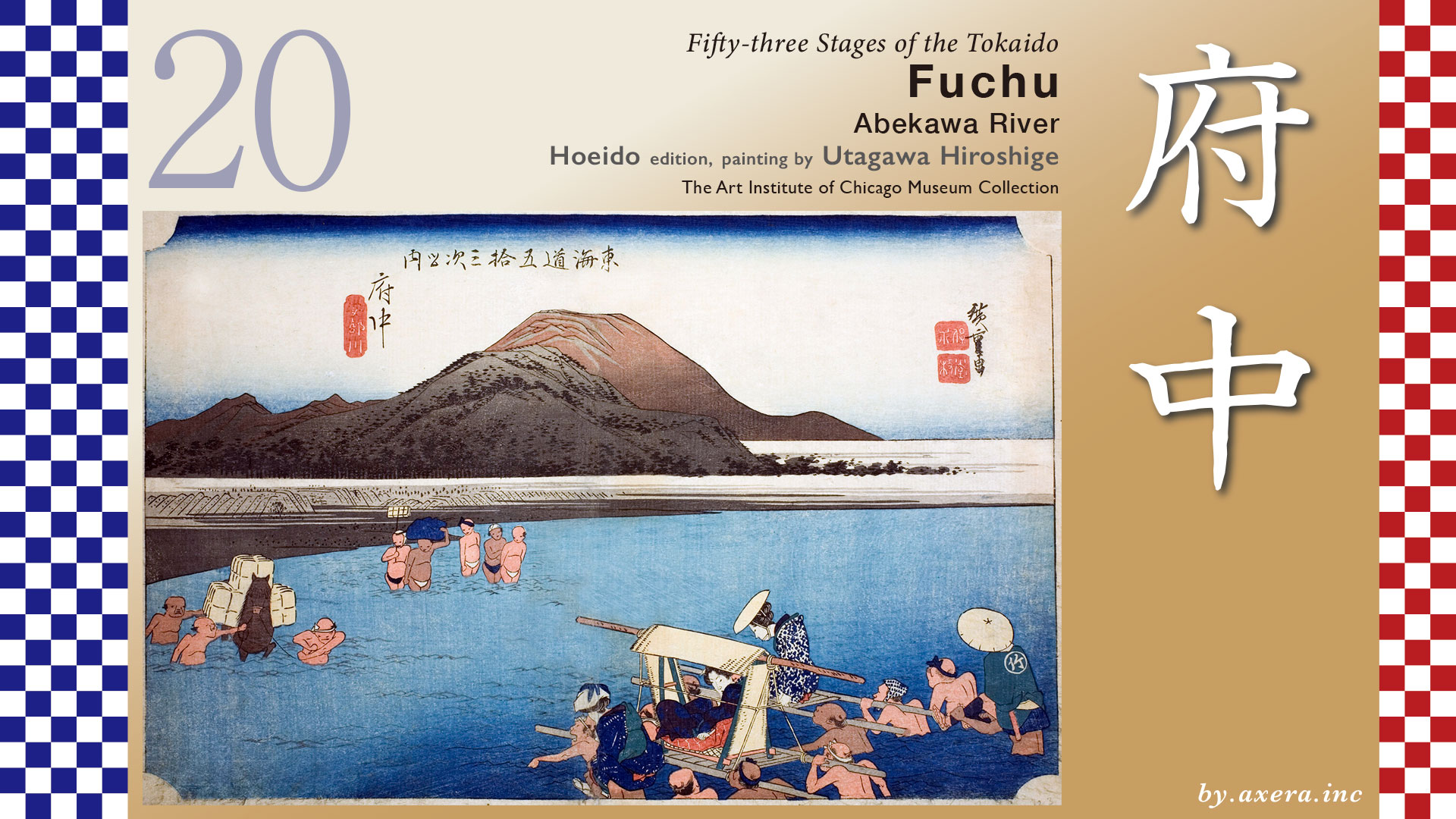
This painting, while called Fuchu, is subtitled Abekawa, or Abekawa River, and thus depicts a river crossing on the Abekawa River. The shape of the mountains in the background indicates that this painting is looking at the Abekawa River from the east.
It is about 11 km from Ejiri-juku to Fuchu-juku, but there is still more than 2 km ahead to a river crossing of the Abegawa River. This is because Tokugawa Ieyasu changed the flow of the Abekawa River during river improvement and moved the Abekawa River, which had been flowing in confusion near Fuchu-juku, to the west side of the river.
The Tokaido passes under the Tokaido Main Line and the Shizutetsu railway line together as it leaves Ejiri-juku, and at the Kusanagi area, it merges with the main road and passes through Ichirizuka.
Furthermore, the area is divided by the railroad tracks as it passes under the Tomei Expressway, but in the Edo period it was possible to go straight along the road.
The Tokaido follows the Shinkansen line north of Higashi Shizuoka Station, and just past the third Shinkansen guard is Higashi-mitsuke, which was the actual entrance to Fuchu-juku.
The Tokaido passes Shin-Shizuoka Station and turns left onto Egawamachi Street. Continue toward City Hall and you will enter Umegashima Kaido and Warashina Kaido. Umegashima Kaido could go to Kofu via Minobu-michi Road. The Tokaido turns left at Isetan on Gofuku-cho Dori and heads south.
The Tokaido then cranks once more, entering Shinmachi Dori and heading for the Abekawakawa River.
To the left, just before the Abekawa Bridge, there is an actual store that still sells Abekawa mochi.
Here is a pictorial map drawn at the time, showing the entire Fuchu-juku area.
Fuchu was where Tokugawa Ieyasu built Sunpu Castle and spent the last years of his life. Under the direct control of the shogunate, the huge town, which stretched to the south of Sunpu Castle, was the second largest as a city after Osaka and Edo. It is said to have had two honjin, two waki-honjin, 43 inns, and a population of about 120,000.
Please take a closer look at the enlarged illustration of Fuchu-juku from east to west here.
Fuchu was also where Tokugawa Ieyasu lived after he retired from the shogunate, and various civil engineering works, in addition to river improvement, were carried out to prepare the area from the west. For this reason, there was also an amusement quarter near the Abekawa River, which was officially recognized by the Shogunate and is referred to alongside Yoshiwara. However, as you can see in the picture, it was more than 2 km away from the center of Fuchu, and travelers had to go to an inn to take a rest before setting up a new horse or palanquin.
There were two types of fees at the Abegawacho brothel: 1,600 and 800 Mon, which, considering that the average fee for a prostitute on The Tokaido at the time was around 500 Mon, means that the fee for a prostitute at the Abegawacho brothel was quite high.The 500 Mon was equivalent to about 170$ per day for a carpenter at that time.
Let us actually take a closer look at Hiroshige’s painting.
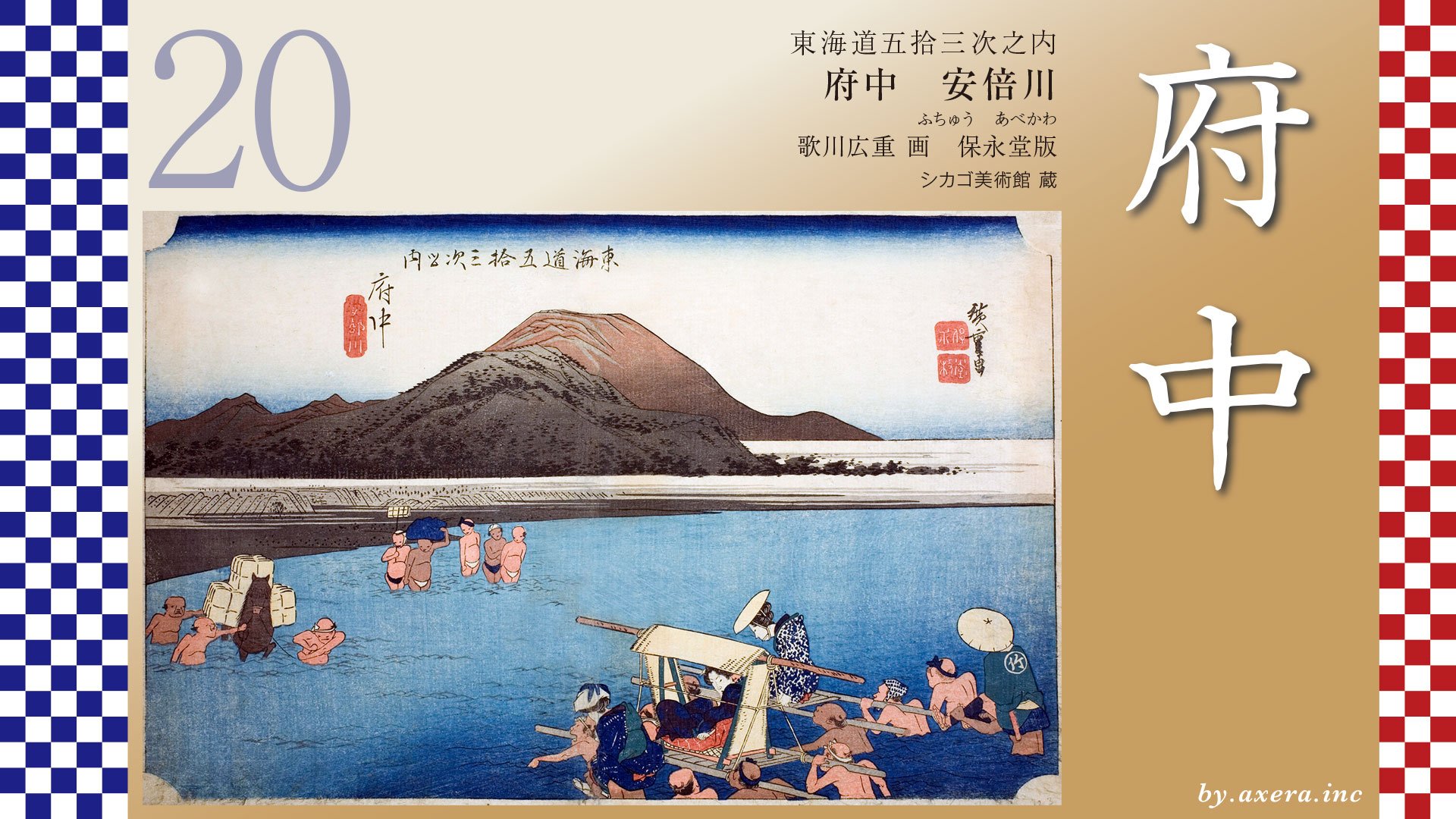
Hiroshige painted several river crossing pictures in this series of the Fifty-three Stages, but this Abekawa River depicts only ordinary people, and a large one at that. In the foreground, the cheapest man and woman on shoulders are crossing the river.
The woman at the far right is riding on a Hira-Rendai, a four-person cart without handrails, which costs six times as much as a on shoulder.
The woman riding in a palanquin on the same Hira-Rendai looks down with concern, as if she is afraid she will get wet. A group of people with horses and luggage are coming across from the opposite bank, and the expressions on the horses’ faces as they pull on their tugs are interestingly contrasting.
At the far end of the opposite bank, there are many bamboo baskets filled with stones for river construction, called “Nakago. The mountain behind it holds a temple called Tokuganji, and to the left and south of it is the next relay station, Maruko-juku.
The Reisho edition depicts the entrance to the Abekawa-cho brothel. The brothel was located on the outskirts of town, and as shown in the painting, customers arrived in palanquinquins or on horseback.
The Gyosho edition depicts a tea store making Abegkawa mochi, a specialty of Abekawa, and travelers coming and going in front of the shop. Judging from the travelers’ attire, they seem to be on a pilgrimage to Ise.
This is the Abekawa Mochi. In the early Edo period, Tokugawa Ieyasu stopped by a teahouse in Miroku, a village by the Abekawa River, and the owner offered him freshly pounded rice cake covered with soybean flour as if it were gold sand from the upper reaches of the Abekawa River. The Abekawa Mochi, which became a specialty because of this legend, can still be enjoyed by the side of the Abekawa River.
Poem editin also depicts the night scene of Abekawa prostitute quarters. It was also known as Nicho-machi prostitute because the size of the prostitute area was two chos in length and width. The appearance is reminiscent of the Yoshiwara prostitute quarters, with willows and such.
Hokusai depicted a type of bamboo work known as Suruga-zaiku. Sunpu produced high quality light-weight bamboo called hachiku, and various bamboo crafts using this bamboo were Sunpu’s specialty products.
I actually went here. Now the river has been widened by river improvement, and there is a magnificent Abekawa Bridge upstream.
Please see the Googlemap Street View with a slightly elevated perspective. This one may look more like the world painted by Hiroshige.
The first shogun, Ieyasu, who moved the Abekawa River away from the city of Fuchu through river improvement, retired from the shogunate in 1605 and handed over the second shogunate to Hidetada. However, he conducted his grand palace politics by conducting his government here in Fuchu, while taking into consideration the authority of the current shogun.
See also Google Street View looking ahead. The Tokaido is now orange.
Hidetada also retired and handed over the shogunate to his son, Iemitsu, who came to Fuchu, but continued to hold political power in Fuchu until his death from illness in 1632.
Looking at the Abegkawa River, one is reminded of the similarities between parents and children.
However, it is also true that these two men set the course for the “peaceful and conflict-free Edo period” that lasted for nearly 300 years.
It should be noted that during the reign of Iemitsu, the third Shogun of Edo, this river crossing for the defense of Edo was abolished and a bridge was attempted to be built. However, the river crossing itself as an industry proved to contribute more to the local economy than expected, and most of the rivers continued to be used for river crossings until the Meiji era.
This river crossing was transformed into an industrial heritage that reflected on past conflicts.
コメント