
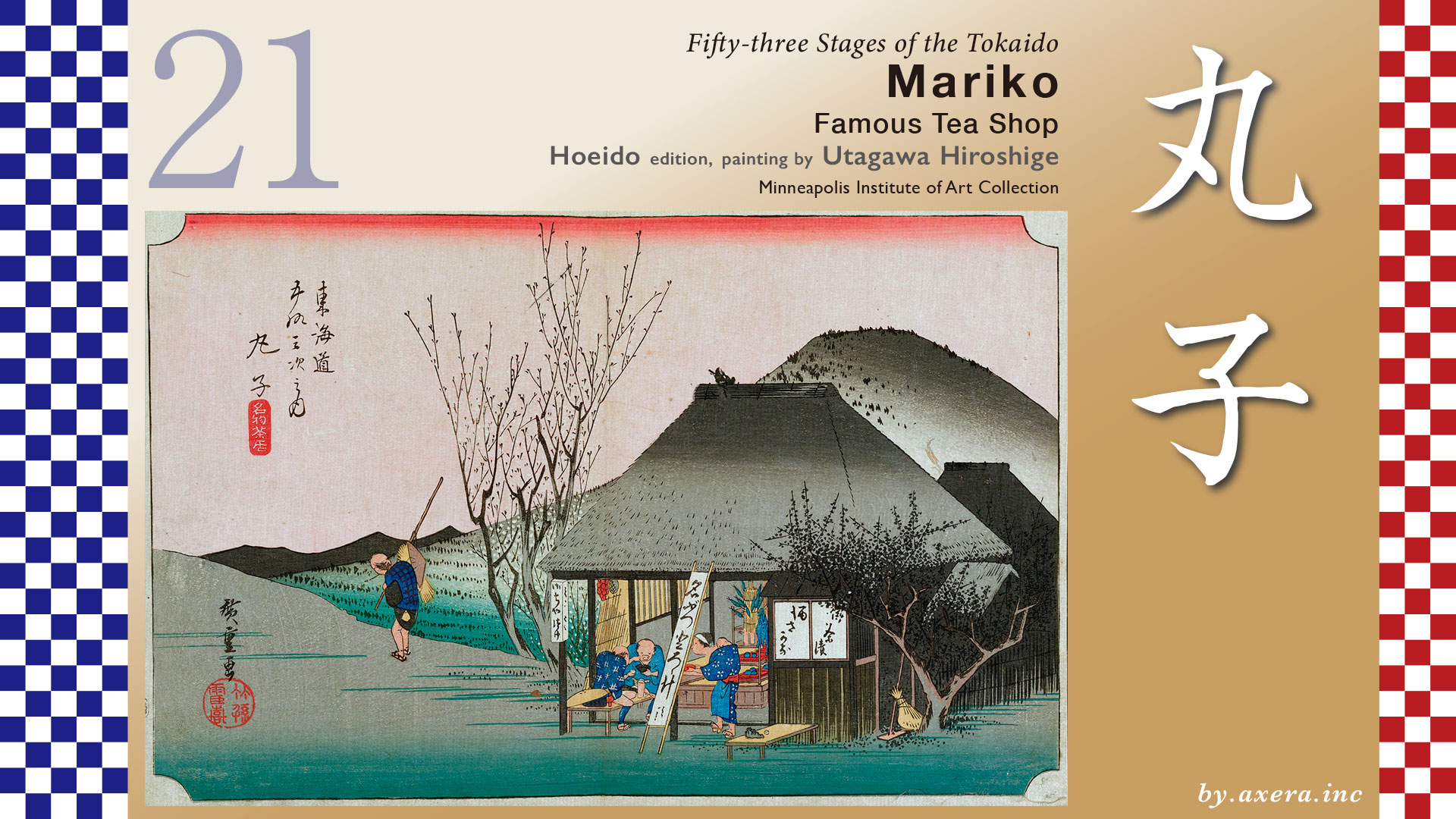
Mariko-juku, the smallest relay station on The Tokaido, had several teahouses at the time, and Hiroshige painted Mariko as one of the “famous teashop”.
Mariko-juku is about 5.9 km from Fuchu-juku, but it only takes about 2 km to reach the entrance of the juku from where you cross the Abekawa River crossing.
Going up from the ferry on the Abe River, you will come to a causeway, and going left will take you along the river to the fishing town of Mochimune. The Tokaido goes straight down the causeway steps and joins the slightly larger current Prefectural Route 208 at Tegoshi, and continues south.
As you enter the town of Mariko, you cross a small river, but in the Edo period, you were greeted by a row of pine trees planted along The Tokaido from this area to the Mariko-juku.
Continuing on, you will cross Ichirizuka and arrive at Mitsuke, the eastern entrance to Mariko-juku. It is about 500 meters from here to the honjin. Just past the honjin, there are several stores selling rice covered with grated yam, which is harvested in the mountains around here.
Here is a picture map showing Mariko-juku as it was then. The rows of pine trees continue from the right side, and when the town begins, it quickly ends, crosses the Mariko River by a bridge, and the rows of pine trees begin again.
Even so, within this 700-meter stretch, there was the Toiyaba, one honjin, two waki-honjins, 211 houses, 24 inns, and a population of about 800 people. There were always about 100 horses in the area, and although it was small, it was still able to fulfill its function as a relay station on The Tokaido.
Let’s take a closer look at Hiroshige’s painting.
Matsuo Basho, a haiku poet who traveled here, left a haiku poem entitled “Ume Wakana Mariko no Yado no Tororo-jiru” (in spring, yam soup is great at the Mariko-juku). Perhaps knowing this, Hiroshige subtitled his painting “Famous Teashop.
As is typical of a teahouse on the outskirts of town, the sign in the center reads “Meibutsu Tororo-jiru” (rice covered with grated yam), the lantern on the right reads “Ochazuke, Sake Sakana”, and the pillar on the left reads “Ochazuke”.
In the Edo period, the mountains around Mariko yielded high-quality yam, and the yam soup made from it was much appreciated by travelers. Travelers may have wanted to eat something that would give them strength in order to safely cross the difficult Utsunoya Pass, which lies ahead.
The photo shows yam soup over rice.
Inside the shop, a traveler eating yam soup and a traveler drinking tea are facing each other with good expressions on their faces, and a mother with a child on her back is carrying something in a red bowl, as if to say, “Please. In the back of the shop, there are many skewers of grilled dried river fish, and many dishes are arranged on a red tray. To the left, a traveler, perhaps finishing his meal, is already heading alone toward the pass with a braided hat and socks slung over his shoulder. The atmosphere of those days is reminiscent of the relaxed atmosphere of those days.
The Chinese characters in the title of the first print of this Maruko-juku are written in “maruiko” (rounded) characters, but all the second prints are written in “mari” (balled) characters.
The name of the land was written “Maruko” (round) and pronounced ‘Mariko’, so it seems that after the second print, the name was changed to “Mari-ko” (ball), which is written as “temari”.
The Reisho edition depicts the entire Mariko-juku as a snowy night. The impression of a relay station in the mountains comes out well in this version.
The Gyosho edition depicts a yam soup store during the plum season as recited by Basho. The old woman who owns the store and the travelers all have nice expressions on their faces.
Poem editin also depicts a yam soup store, but this one seems to be a store at the end of a relay station, since there is a stone wall behind it. In addition to travelers wearing hats, various other people are depicted, including palanquin carrying people taking a break, and guests of samurai families enjoying the yam soup.
I actually went here. Surprisingly, a yam soup store that looks exactly like Hiroshige’s painting is still in existence. This is the Chojiya. It is not known if Hiroshige actually painted this Chojiya, as there are records of several yam soup shops operating at the Mariko-juku at that time.
In order to recreate the world of Ukiyo-e, the restaurant, which has been in business since 1596, moved to its current location in 1970, deliberately relocating from an old house in the early Edo period. Here, the world depicted by Hiroshige was a reality. Of the 55 paintings in the Fifty-three Stages, this Mariko-juku is the only place where one can actually see the world almost exactly as it was depicted in the paintings. When you see it, it makes you scream a little.
The Tokaido looking back from in front of the Chojiya is now very much in the style of The Tokaido. The road twists and turns little by little as it heads toward the Abekawa River.
We were not able to get their yam soup at Chojiya since they are only open for lunch, but we were able to find a picture of it from Street View.
Nevertheless, when one actually encounters the world of the the Fifty-three Stages paintings that Chojiya is recreating, one feels a little thrilled and lost in an indescribable sense of nostalgia.
Please look ahead here in GoogleMAP street view. The Tokaido is now orange. This is what a small village in the mountains looks like now. The road running to the right of The Tokaido is present-day Route 1, the main street of Mariko, which joins the Route 1 bypass ahead. The Tokaido follows the Mariko River, winding through the mountains from here to the difficult Utsunoya Pass.
コメント