
Fifty-three Stages of the Tokaido
Akasaka
Inn with Serving Maids
Hoeido edition, painting by Utagawa Hiroshige
The British Museum Collection
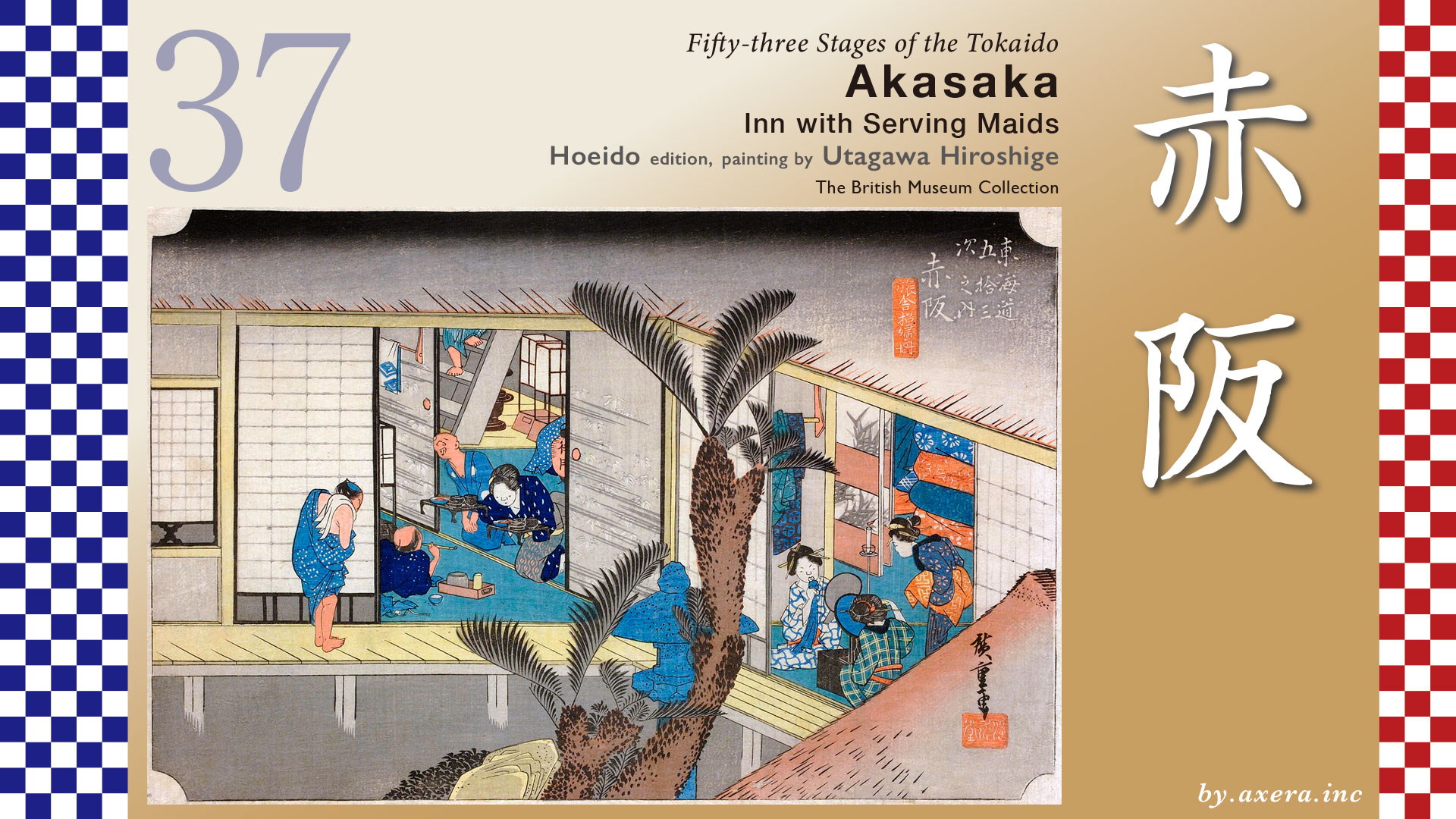
This painting depicts the inn at Akasaka-juku as if Hiroshige were peering into the room across the courtyard.
The distance between Goyu-juku and Akasaka-juku was only 1 mile.
Right in the middle of that stretch lies the famous pine tree-lined path in Goyu.
It is said that this place still retains its appearance almost unchanged from that time. While there are many recreated pine tree avenues along the Tokaido, such as at Maisaka, this is the only place where a long pine tree avenue from that era remains, making it a precious location where one can imagine traveling the Tokaido during the Edo period.
Looking at the delivery note from that era, it reads “Akasaka, Goi.” ‘Goi’ refers to Goyu, and the two post stations were collectively called “Goyu (Goi).” Akasaka and Goyu were considered a single unit. The villages themselves were adjacent, with this row of pine trees marking their boundary.
By dividing the juku, an unspoken rule apparently developed: when traveling from Kyoto to Edo, daimyo processions used Akasaka-juku, while when heading from Nihonbashi to Kyoto, they used Goyu-juku.
Continuing past the pine trees, once you see the large camphor tree and Akiha Shrine, you’ve reached Akasaka-juku.
Coming from the east, the Tokaido merges with the Hime-Kaido just before the Otowa River. Here, you’ll first face the somewhat aggressive solicitation tactics of the Tomeonna-women of Goyu-juku. After navigating past them and walking about 15 minutes, you’ll encounter the Tomeonna-women of Akasaka-juku lying in wait, eyes fixed on you. Since Fujikawa-juku lies nearly 9 kilometers ahead, this is a place to pause and consider your options.
This depicts the daily life of a rice-serving woman in Goyu-juku, as painted by Katsushika Hokusai.
It is said that Goyu-juku had over 100 inns, while Akasaka-juku also had about 83 inns, where numerous women known as “Tome-onna” worked as hostesses. These Tome-onna were essentially rice-serving women, and most were private prostitutes who existed in Edo-period juku.
During the Edo period, licensed courtesans were only permitted to operate within officially sanctioned brothels like Shin-Yoshiwara in Edo. However, rice-serving women were tacitly tolerated under the designation of “servants of the inns of juku.”
Also known as shukuba joro (prostitutes in juku), Akasaka, Gozu, and Yoshida were particularly renowned along the Tokaido for their large numbers of rice-serving women.
Many of these rice-serving women were daughters from nearby farming villages or juku along the Tokaido.
A record from the year of 1789: “Unable to pay the annual tribute, they sent their daughter to serve as a rice-serving maid. She was 11 years old this year, with a fixed term of 12 years. They received 1 ryo 2 bu as payment and submitted it as tribute.”
The Edo-period essayist Ota Nanpo, also known by his pen name Shokuzan-jin, recorded his impressions while traveling the Tokaido in 1801.
From Goyu to Akasaka, a distance of sixteen cho, there was only one juku. Though both had many courtesans, Goyu was vulgar, while Akasaka was pleasant.
Now, let’s take a closer look at Hiroshige’s painting.
The rock in the courtyard and the sago palm growing from it divide the scene into left and right sections. The left side shows the room where travelers stay, while the right side is the waiting room for the prostitutes.
On the left, a guest who has just finished bathing, draped in a towel over one shoulder, has returned to his room. To his right, a guest smoking a pipe sits on a bench with a towel hanging above him, indicating he has already bathed. From the right room, a maid timed perfectly carries in a tray of food for two, followed by a masseur checking on evening appointments.
In the far back, only the waist and lantern of a figure—likely a relay courier carrying an official letter box along with a duty lantern—are depicted.
To the right of the sago palm, courtesans are depicted, busily applying makeup and preparing themselves before a mirror by the light of a single candle. The woman standing to their right is the courtesan’s manager, akin to the madam of a brothel. The overlapping futons visible behind them indicate this is the futon room.
The subtitle of the painting, “Serving Maids” , is formally read as “deonna” or “ojare,” referring almost exclusively to women who served meals. Therefore, ‘Inn with Serving Maids’ means “The Scene of Prostitutes at an Inn Serving Meals.”
The Reisho edition depicts the scene of the post town from a distance, slightly toning down the intensity of the touts in Akasaka-juku. The figures of various people allow us to sense the atmosphere of the relay station at that time.
The Gyosho edition depicts the scene of imperial couriers and travelers carrying Odawara lanterns passing each other under the moonlight along the pine-lined avenue between Goyu-juku and Akasaka-juku.
The Poem edition depicts the western entrance of Akasaka-juku, as the stone-piled gatehouse is visible. It shows a somewhat lonely returning palanquin and a horse dealer.
I actually visited this place. The inn depicted by Hiroshige was called “Iemon Koiya,” and it is said to be the current Ohashiya. It still retains its appearance as an Edo-period inn and is designated as a municipal cultural property. Until 2015, it actually operated as a ryokan.
Approaching the angle of Hiroshige’s painting, it might look something like this. This is a view of Ohashiya from the rear, featuring a sago palm and stone lanterns—it seems to be consciously echoing Hiroshige’s composition.
This is the Tokaido looking toward Goyu, with Ohashiya on the right. The Ozakiya shop ahead on the left is a bentwood crafts shop, a type you don’t see much anymore. They handle items like trays, buckets, and lunch boxes made by bending thin sheets of cypress or cedar wood.
This is a photograph of the Tokaido, with Ohashiya on the left and a slight uphill slope. Climbing this slope toward the mountains, you soon pass through Akasaka-juku.
Akasaka-juku was also a very lively post town in its day. However, when the current Tokaido Main Line was opened, it was bypassed. Consequently, like Goyu-juku, it became a town far removed from its former bustle. The relay station town where men and women once engaged in lively banter is now a very quiet place.
After that, although a station on the Meitetsu Nagoya Main Line was established, it never regained its former prosperity. Today, this Meiden Akasaka Station, like the former Goyu Station, is a somewhat lonely unmanned station where express trains pass by.
Using Google Street View, I looked ahead from a slightly elevated vantage point. The Tokaido, with travelers who escaped the the Tomeonna-women, winds through the mountains along the Otowa River toward the next post station, Fujikawa-juku.
コメント