
Fifty-three Stages of the Tokaido
Fujikawa
Scene at Post Outskirts
Hoeido edition, painting by Utagawa Hiroshige
The Art Institute of Chicago Museum Collection
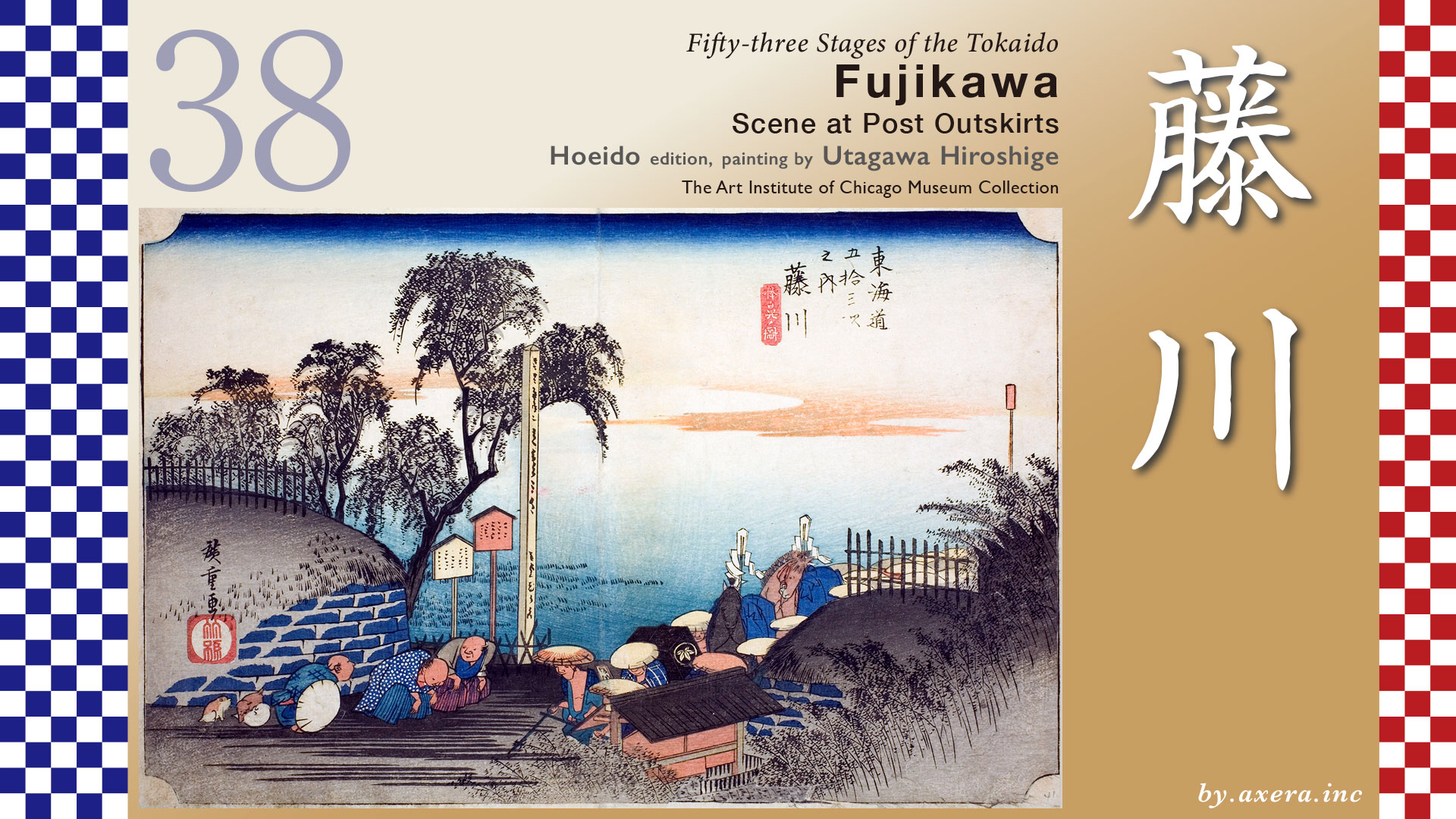
This depicts the scene of horses presented by the shogunate to the Imperial Court entering Fujikawa juku.
The distance from Akasaka-juku to Fujikawa-juku is just under 9 kilometers, running almost straight through the mountains.
Leaving Akasaka-juku, just before Nagasawa Station, stood the Nagasawa Ichirizuka milestone. At that time, Nagasawa Castle could be seen to the right.
After passing Motojuku Station, the Tokaido merges once more with National Route 1 and continues onward until just before Fujikawa-juku.
Before National Route 1 passes under the Meitetsu railway tracks, the Tokaido veers left onto a small path, and just ahead lies Higashi no Bohana, Post Outskirts,depicted in Hiroshige’s paintings.
From Higashi-no-Bohana lay Fujikawa-juku, and to the left, atop the mountain, Fujikawa Castle could be seen. Now, passing the honjin where the museum stands, one soon reaches Nishi-no-Bohana and leaves Fujikawa-juku behind.
Hiroshige appears to have viewed the eastern end of the pier, also known as Edo-mitsuke, from the south toward the northeast. I’ve added that viewpoint using a red gradient.
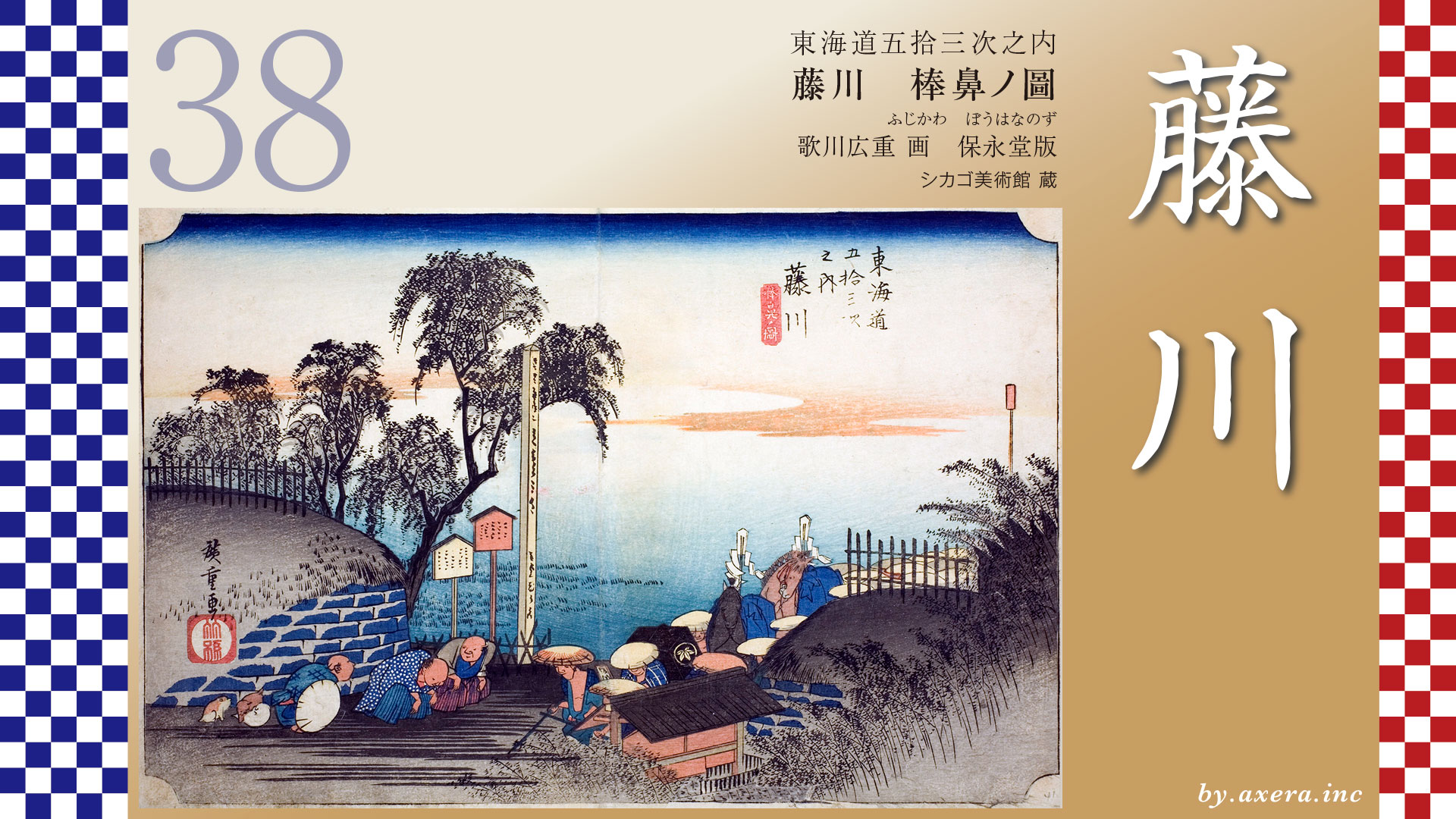
The wooden pole standing in the center of Hiroshige’s painting is a boji-kui, marking the entrance to Fujikawa-juku. This spot, serving as the gateway to the relaly station, was called the “Bohana”, Post Outskirts. Within the bamboo fence, two Kosatsu for announcements are also erected. Fujikawa-juku’s Bohana served as a endgate of juku, reinforced with stone walls and earthen ramparts. The official seated on the left, dressed in a haori and hakama, is responsible for receiving the horses. The traveler on the left happened to be present and is seated for now, but looks utterly bewildered. To his left, a plump puppy, seemingly oblivious to the samurai, is playfully wrestling with another puppy―a truly adorable sight.
The procession features black and brown horses adorned with sacred paper streamers, preceded by a group carrying the sacred chest, and ahead of them, two purifiers holding ceremonial rods. Both horses are meticulously groomed, even their manes, looking as if they were brides about to be married off.
In the summer of 1832, when Hiroshige was 36 years old, he traveled along the Tokaido from Edo to the capital of Kyoto, following the procession of the shogunate’s Hassaku Horse Offering. An original painting depicting this scene remains at the Tokyo National Museum.
By the Muromachi period, gift-giving customs had become established within samurai society, and exchanges of gifts also occurred between the shogun and the Imperial Court. In the Edo period, the shogunate designated the presentation of horses to the Imperial Court on August 1st as an important ritual, calling it the “Hassaku Horse Offering Ceremony.” This is what we would call the summer gift exchange. This term “Hassaku” refers to August 1st.
Hiroshige’s painting depicts the very moment when this procession of the Hassaku Horse Offering entered the Edo mitsuke at the eastern end of Fujikawa-juku, known as Bohana. Upon enlarging the painting, the front of the procession bears a striking resemblance to the scene depicted in the Fujikawa-juku print. It is said that the series “Fifty-three Stages of the Tokaido” was painted using sketches made during this event, though the veracity of this claim remains uncertain.
The Reisho edition depicts this procession advancing over the mountains near Yamanaka Village, further ahead. The vanguard group of lead boxes is omitted, with muskets and bows taking the lead instead.
The Gyosho edition depicts a more advanced shop in Yamanaka Village. In Yamanaka Village, household goods made from ramie fiber―a type of hemp―twisted into rope-like strands were sold as local specialties.
The Poem edition, in contrast, depicts the snowy road from a slightly elevated perspective. It appears to emphasize the gentle slope at the edge of the relay station.
I went to see the eastern Bohana that actually became the subject of Fujikawa-juku’s painting. Beyond the houses ahead lies National Route 1.
Viewed from the opposite side, features like the boji-kui, earthwork, Kosatsu, and hedges replacing bamboo fences―as depicted in Hiroshige’s paintings―were also recreated. Hiroshige himself, as a member of the shogunate, passed through here about 190 years ago on his way into Fujikawa-juku.
The town now stands as a single road with gentle undulations, retaining the vestiges and atmosphere of Edo.
I took a look at the direction of travel from slightly above using Google Street View. After passing the eastern end of the town, the Tokaido immediately curves into a crooked shape―quite typical of a castle town, isn’t it? Locals called this the “kanente”. The townscape back then was designed with warfare in mind, stretching as far as the eye could see.
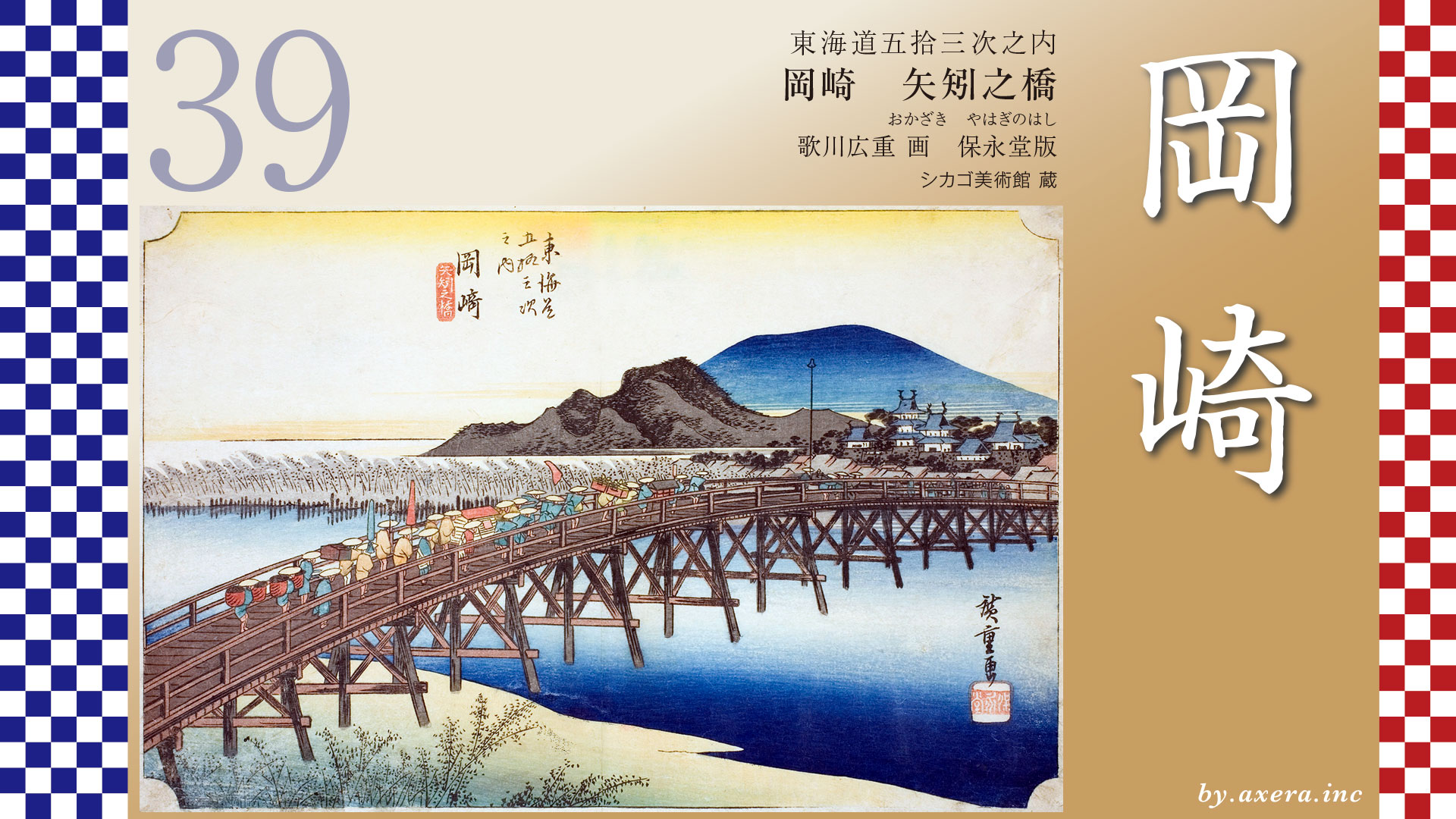
After passing Fujikawa-juku, the Tokaido crosses the Meitetsu railway tracks, rejoins National Route 1, emerges from the mountains, and heads toward Okazaki-juku, the birthplace of Tokugawa Ieyasu.
コメント