
Fifty-three Stages of the Tokaido
Kameyama
Weather Clearing after Snow
Hoeido edition, painting by Utagawa Hiroshige
Metropolitan Museum of Art Collection
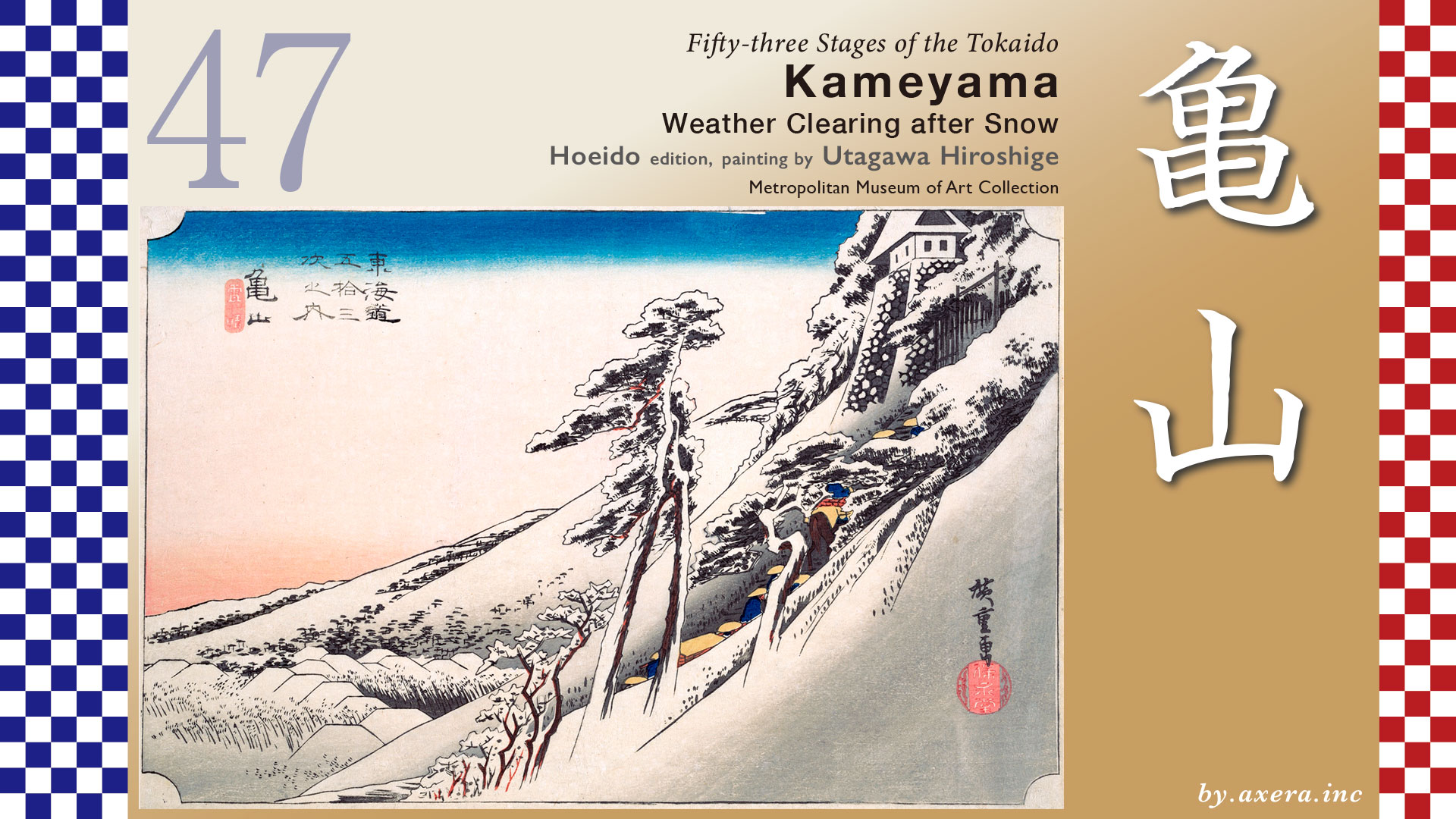
In the quiet stillness of a snow-cleared morning―
a procession slowly makes its way up a slope.
At its destination stands a famed castle gate, while the figures of a daimyo’s retinue appear small within the scene.
From Ishiyakushi-juku, Shono-juku lies just 2.9 kilometers away.
But from there to Kameyama-juku, the journey stretches another 7.8 kilometers―no short distance for travelers of the time.
Leaving Shono-juku, the road follows the left bank of the Suzuka River, continuing almost entirely flat until it reaches the Ichirizuka-milestone at Nakatomita.
Before long, the route crosses two tributaries―the Anraku River and the Muku River―after which the Wada Ichirizuka-milestone comes into view.
As Kameyama Castle begins to appear on the elevated ground ahead to the right, the road comes to an end.
This is the Edoguchi-mon gate, marking the beginning of Kameyama-juku.
Turning right along the road past the gate, one encounters the characteristic bends of a castle town.
Then suddenly, the road rises sharply into a steep slope.
Today, a stone marker for Kameyama-juku stands nearby, and at the end of this stretch once stood the toiyaba relay station office.
This area opens into a wide vantage point, offering a view that evokes what one might have seen looking out from Kameyama Castle itself.
Continuing further, the townscape still retains traces of its past as a post town.
And beyond it lies the very spot depicted by Hiroshige.
Though a bridge now alters the route, in those days the road became steep immediately after passing the Kyoguchi-mon Gate.
On the map, the likely viewpoint of the artist is indicated with a red gradient.
From an aerial view looking south, the approximate area of Kameyama Castle is highlighted in blue.
Built in the mid-16th century, the castle later flourished under the Seki clan, and then under the Ishikawa clan as a castle town along the Tokaido.
Though not large in scale, Kameyama-juku possessed a unique liveliness of its own.
From the mid-Edo period onward, the Tokaido thrived with travelers on pilgrimages to Ise.
Yet Kameyama, Shono, and Ishiyakushi lay slightly off the main route.
Kameyama-juku, however, was an exception.
A secondary road―known as the Kameyama-michi Road―led south from the castle town and rejoined the Ise pilgrimage route.
On the map, this road is shown as a white line.
Thanks to this connection, many travelers chose to stop in Kameyama―
to explore, to admire the castle, and then continue on toward Ise.
This is a scene of Kameyama-juku bustling with pilgrims on their way to Ise, generated by AI.
To depict this vibrant place, Hiroshige chose a striking composition:
the mountain ranges rising to the west, and the magnificent Kyoguchi-mon Gate.
Celebrated in local verse, the gate stood in grandeur, with stone walls, turrets, and wooden palisades.
The snowfall has ended.
Morning light spreads across a clear sky, stretching far into the distance.
In this soundless landscape, a small procession climbs a steep slope toward the gate―
its quiet movement heightening the stillness of the snow-cleared scene.
To the left lies the village of Nomura;
to the upper right, the Kyoguchi-mon Gate rises, depicted as if viewed from below.
The entire composition forms a carefully orchestrated landscape.
In reality, however, the terrain differs somewhat.
The road approaching the gate was nearly flat, followed by a descent, a river crossing, and then another climb.
In other words, Hiroshige did not reproduce the landscape exactly as it was―
but rather reimagined it into a more evocative scene.
Even so, details such as the castle walls, turrets, and wooden fences align with historical records.
It is this delicate balance between reality and artistic interpretation that gives the work its enduring appeal.
Today, the gate itself is gone, leaving only an information marker.
Yet the terrain remains steep, allowing visitors to imagine the path as it once was.
In the Reisho edtion, the scene shifts to spring, depicting the grand Otemon Gate.
Kameyama Castle was built on a river terrace along the left bank of the Suzuka River.The Tokaido passed just south of the castle, so upon exiting through the Otemon Gate, travelers would immediately find themselves on the Tokaido―
with a full view of the castle rising before them.
Hiroshige even included figures of travelers gazing up at the castle, capturing a quietly charming moment.
In the Gyosho edition, the scene moves beyond Kameyama-juku,
where laborers rest in front of a pine grove near the Nomura milestone.
Meanwhile, the Poem edition presents the Kyoguchi Gate itself, as seen from the Kyoto side.Historical records describe stone walls, wooden palisades, a crowned gate, and a guardhouse flanking the gate―details that align closely with this depiction.
Visiting the site today, one finds that the Kyoguchi-mon Gate once stood just ahead to the right.
The road here is now flat, though it begins to slope downward after passing the former gate site.
Today, the Kyoguchizaka Bridge spans the river beyond, allowing passage toward Seki.
This photograph shows the location of the former gate from the south.
Only an information marker remains.
Turning back to look south, one sees a steep drop―
suggesting that the old Tokaido once descended in a winding path toward the river.
A sign at the site displays an early Meiji-era photograph, likely taken from below, looking up at the Kyoguchi-mon Gate from the river.
From this, it becomes clear that before the bridge was built, the road curved its way down to the riverbank.
It is possible that Hiroshige misunderstood the direction and incline of this approach when composing his image.
Even so, the result is not entirely far from reality.
Here, we also present an AI-generated image―
While not depicting a slope, it captures something close to the original atmosphere.
Through modern street views, the landscape beyond can also be explored.
Compared to Hiroshige’s work, one notices how the mountains and buildings have been subtly exaggerated.
From this point, the Tokaido leaves behind the magnificent Kyoguchi-mon Gate,
descends the slope, crosses the river, passes through Noguchi,
and follows the Suzuka River upstream toward Seki-juku.
And ahead, in the distance―
the mountains of Suzuka begin to rise into view.
コメント