Fifty-three Stages of the Tokaido
Kanaya
Totomi side shore of the Oigawa River
Hoeido edition, painting by Utagawa Hiroshige
Metropolitan Museum of Art Collection
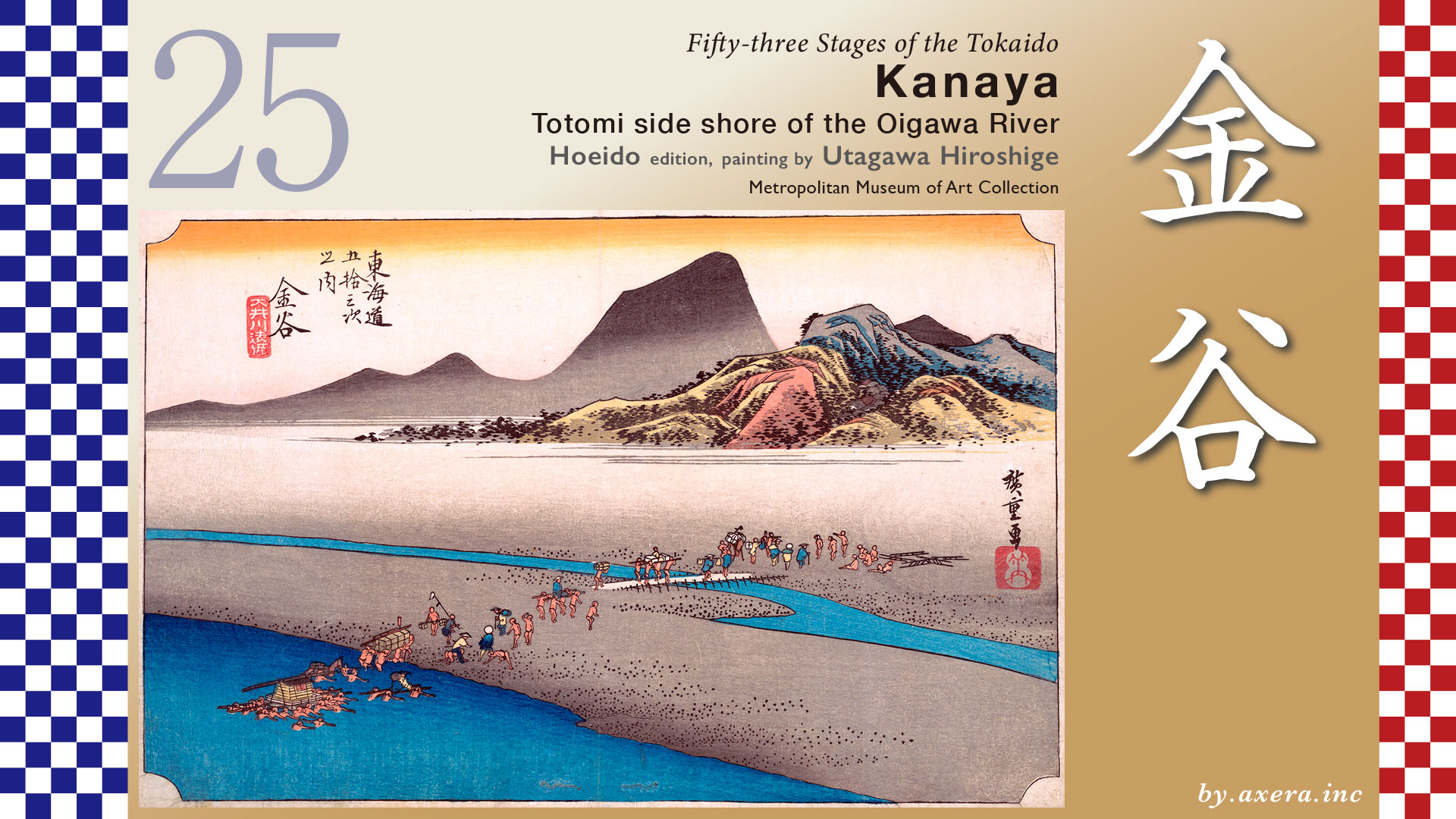
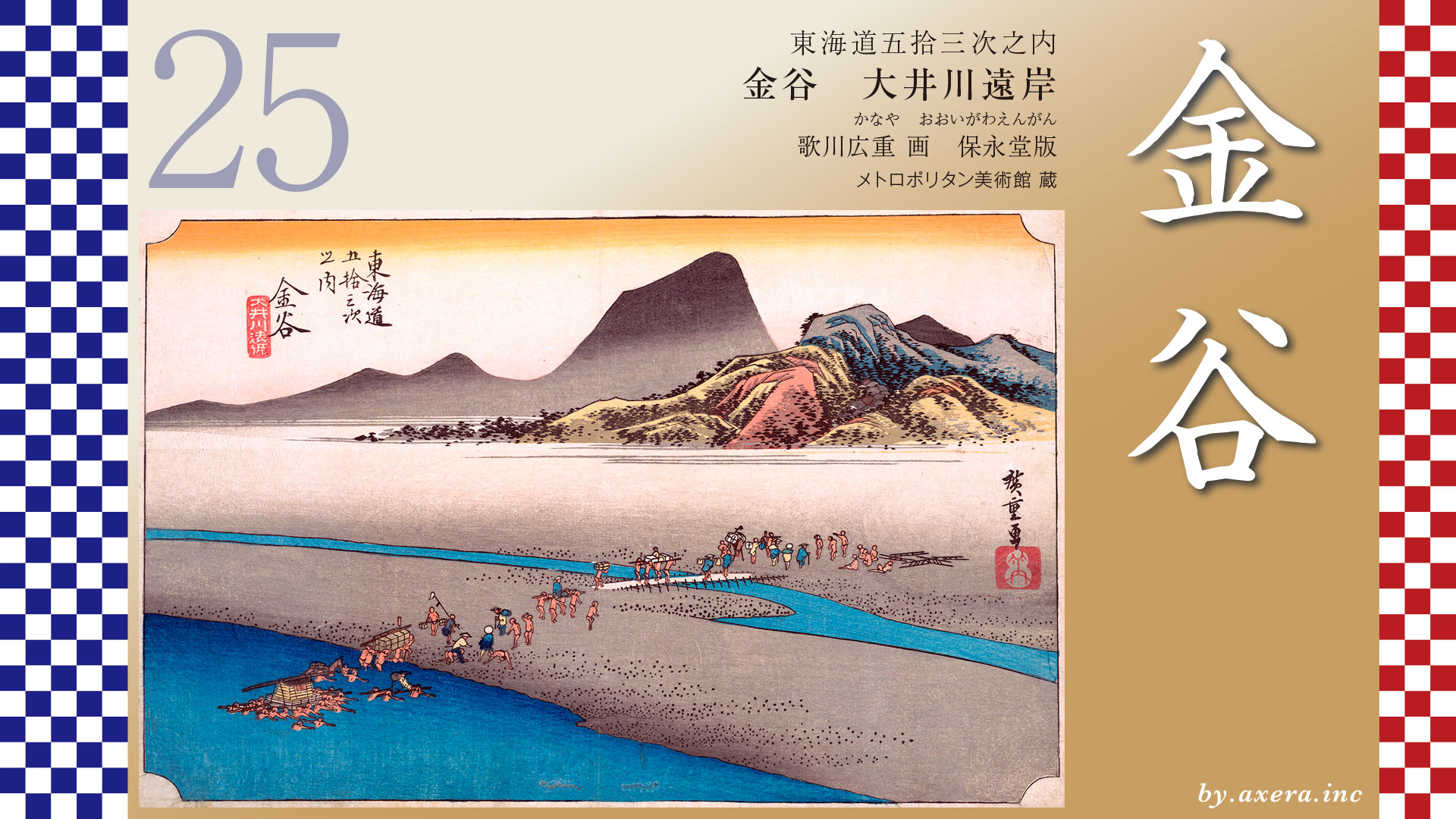
This is a view over the Oigawa River from the center of the Oigawa River looking toward the shore of Kanaya-juku. Kanaya is at the far right of the picture, and Shimada is at the lower left.
The road from Shimada-juku to Kanaya-juku is about 3.9 km long, and about 1/3 of it is occupied by the Oigawa River. In Hiroshige’s painting, the view toward Kanaya is seen from above the sandbank of the Oigawa River. I added a red gradation to the image.
The Tokaido 53 Stages depicts Shimada-juku as “Suruga side shore of the Oigawa River” and Kanaya-juku as “Totomi side shore of the Oigawa River” a subtitle. The Tokaido leaves Shimada-juku and nears the Oigawa River, where you will find the Shimada-juku Oigawa Kawago-shi Iseki, which recreates the facilities used for crossing the river in those days. Here, visitors can see what it was like to cross the river in those days at a museum, a river meeting place, and reproductions of objects from the river crossing.
In the Edo period, there were no bridges across the river, so it was necessary to pay money here to hire a kawagoshi-ninsoku to cross this Oigawa River. The width of the Oi River at that time was about 1.3 km, and the cheapest way to cross the river was to have a kawagoshi-ninsoku carry you on his shoulders.
Crossing over to the Kanaya side, there used to be a row of over-the-river facilities just like those on the Shimada side, but now there is only a small facility called “Kanaya-juku over-the-river place ruins” in front of the river.
After crossing over to the Kanaya side, a short distance later you will cross the Oshiro River. Although there are no traces left now, this area was approximately the eastern end of Kanaya-juku.
Let’s take a closer look at Hiroshige’s painting. The number of people appearing in Hiroshige’s painting of Kanaya-juku is a little smaller than that of Shimada-juku, isn’t it? Moreover, this painting depicts only the procession of feudal lords. The lord, still in the river, is riding in a palanquin on a palanquin stand called a daikoran palanquin, which is the most luxurious palanquin with railings on all four sides and carried by 24 people. The palanquin is carried on a palanquin, which is the most luxurious type of palanquin, with handrails on all four sides.The luggage was also carried by six people, so it must have been very heavy.
The first retainer carrying a spear and a sakibako-box is already walking down the sandbar, and in front of him is a samurai on a shoulder carrying a palanquin over the river. Ahead of them, a samurai on a palanquin stand, carried by four men, is being carried along the sandbar. A small bridge has been built over the river, and some people are still being carried on their palanquin.
On the other side of the river, to the right, you can see an interesting-looking man in a loincloth relaxing beside his palanquin after a hard day’s work. Beyond the haze of clouds, you can see the roofs of houses surrounded by mountains. The high gray mountain at the far left does not exist on the map.
This is the second print, and the Kanaya-juku is brightly painted, making it very easy to understand.
If you look closely, you can see that the bridge on the way has been repainted. Also, the gray riverbanks have been repainted yellow to give the impression of sunlight.
If you go back to the first print and compare the two, you can see it clearly.
The fee for crossing the Oigawa River varies depending on the amount of water and the width of the river on any given day. An official at the river meeting house checks the river every morning, and the fee is posted at the entrance of the river meeting house. See the difference in the amount of money on the river ticket, which varies depending on where the water level is in the human footprint.
Since the average water level of the Oigawa River was about 76 cm, it was usually higher than the “lower back” level, and since an assistant called tebari was needed, two river ticket were required. The lowest price for a shoulder-carriage style would be at least 104 mon, which is about 5200 yen in today’s money.
Please take a look at “Oigawa no Zu,” a series of three paintings on The Tokaido by Hiroshige. Various people are depicted riding on palanquins. This is a great opportunity to see in detail what was going on on this river.
A “river ticket” was purchased at the river meeting house, and one river ticket was worth the Kawagoshi-ninsoku one man for each river ticket. Therefore, the woman on the left in the photo on a flat palanquin requires seven river dockets, including those of her assistants called “tebari.
With the river at its current level, one river ticket costs 94 bunds, which is approximately 4,700 yen in today’s terms, and seven river tickets would have cost at least 32,900 yen. So, we can see that this river crossing had a considerable economic effect on the area.
Fuji in the foreground of the painting. The most expensive palanquin for lords and court nobles, called a daikoran palanquin, was on display at the Oigawa Kawagoshi Site in Shimada-juku.
According to the situation depicted in the “Oigawa no Zu,” it would have required 24 kawagoshi-ninsokus, 4 assistant tebari, and 16 palanquin tickets, so 56 river tickets would have been needed. In today’s terms, this would amount to 263,200 yen.
The Reisho edition looks back toward the Oigawa River from Kanaya-zaka, past Kanaya-juku, which was said to be a difficult spot.
The Gyosho edition shows the same river crossing with a picture of a daimyo’s procession and sumo wrestler being carried. The sumo wrestler must have been quite heavy, and it is interesting to see them being carried by a large group of Kawagoshi-ninsokus.
Poem editin depicts a scene of a daimyo’s procession crossing a river. It is interesting to see the many palanquin stands scattered about, probably because of the budget. The river meeting house was in charge of deciding the order of the day’s procession, and it seems that the daimyo’s procession had the highest priority.
I have actually been here. This is a picture looking toward Kanaya from the top of what is now the Oigawa Bridge, since Hiroshige’s viewpoint is over the middle of the river. I was able to take this picture just like Hiroshige’s painting. The village on the right is Kanaya-juku, and there was a path up to the bank after crossing the river around the small staircase on the far left.
This is a photo looking back toward Shimada from the bank. The view of the Oigawa River as well as Mt. Fuji over the river is exactly the same as the view over the river in Hiroshige’s “Oigawa no zu” series of three paintings.
Going down the bank, you will find a facility called “Kanaya-juku Kawakoshi place site” , where a statue of the person who played a leading role in saving Kawakoshi-ninsokus in the Meiji era stands.
In 1870, the kawakoshi system, which had been a major industry on the Oigawa River, was abolished, and the approximately 1,300 kawakoshi-ninsokus on the Oigawa River lost their jobs.
At that time, the Meiji government, which was considering export trade of tea after the opening of the port of Yokohama, had begun to cultivate tea fields mainly by some former shogunate vassals. Genzo Nakata was one of those who rose to the occasion. He cut off his own topknot, sold his land to raise funds, and then went to the Meiji government to appeal directly for help to the mass unemployed Kawagoshi-ninsokus.
It is said that one of the reasons why Shizuoka became the tea-producing region that it is today is because of the large number of Kawagoshi-ninsokus who changed their jobs to tea cultivation.
The Tokaido is depicted in orange on Googlemap Street View.
You can see that there is a series of mountains beyond Kanaya-juku, where travelers passed through the turbulent times of the Tokaido. For travelers in those days, a muddy mountain crossing awaited them after crossing the Oigawa River, which they had barely crossed.
Price of one river ticket
Waki-doshi=armpit 94mon=$32
Chichi-doshi=breast 78mon=$26
Obiue-doshi=above the waist 68mon=$23
Obishita-doshi=lower back 52mon=$18
Mata-doshi=length of the legs 48mon=$16
1mon is calculated at $0.3
コメント