
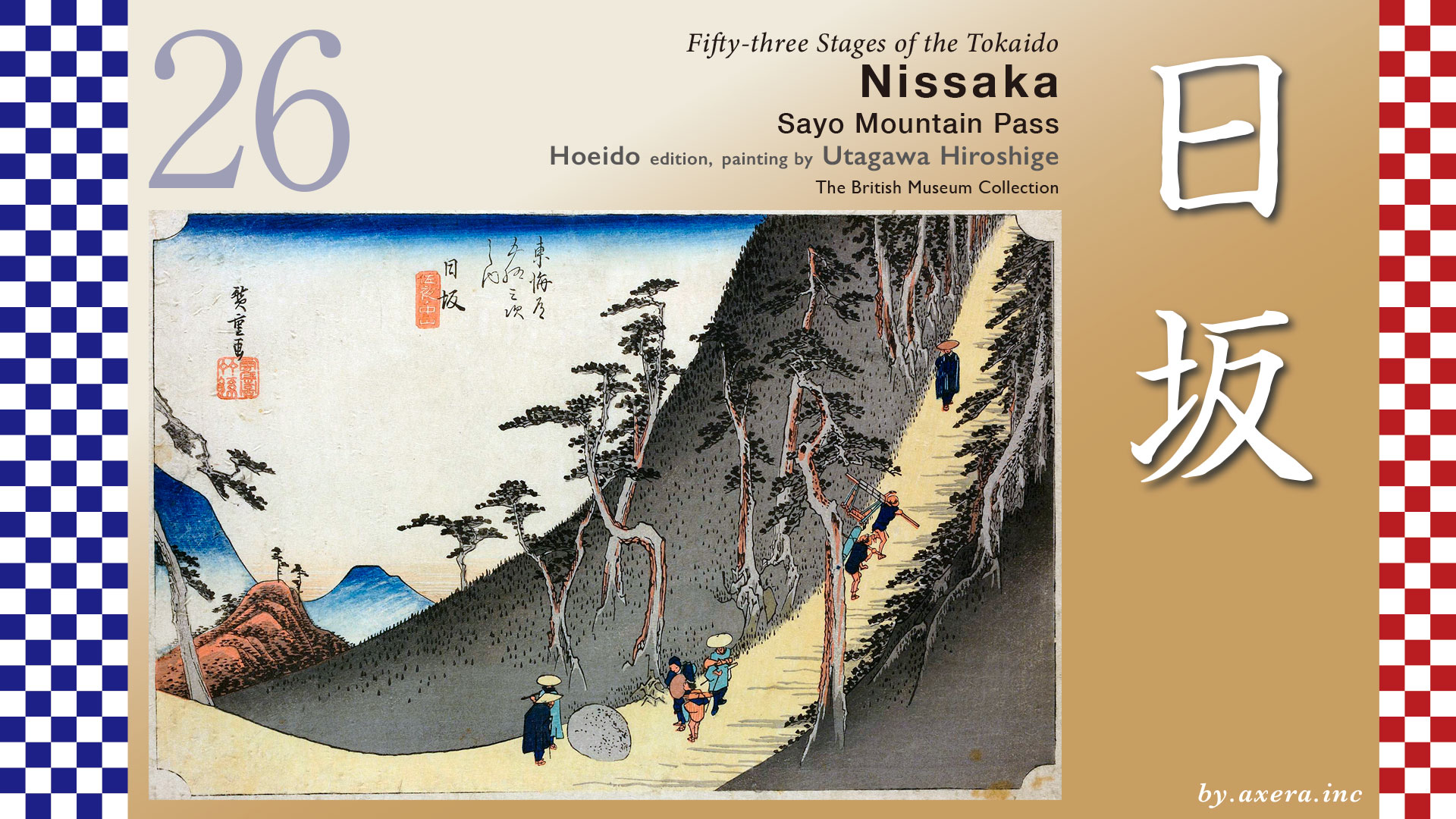
This painting depicts the Yonakiishi (Night-Weeping Stone), located just before reaching Nissaka-juku after passing through Saya-no-Nakayama Pass.
The distance from Kanaya-juku to Nissaka-juku is about 7.1 km, but the location depicted by Hiroshige in his painting of the Night-Weeping Stone was about 1 km before Nissaka-juku.
Leaving Kanaya-juku, the Tokaido passes under the JR Tokaidō Line and continues behind the station, reaching the stone-paved Kanaya Slope. From here to Nissaka-juku, the Tokaido traverses a route of steep ascents and descents.
During the Edo period, Kanaya Slope was not only steep but also exposed a layer of clay known as “aoneba.” When it rained, the muddy conditions made travel extremely difficult for travelers. Consequently, in the latter half of the Edo period, stones were laid over a stretch of approximately 720 meters, creating a paved stone path that was much easier to walk on.
This stone pavement was also constructed on the Kikugawa side. While this section slopes downward, it has been partially restored and can still be seen today.
Beyond that, Kikugawa-juku also served as an intermediate juku. Passing it, one ascends the mountain path known as Sayonaka-no-Nakayama. The area at the top is now covered in tea fields.
As you walk along the scenic tea fields, Kyuenji Temple comes into view on your right.
This temple is deeply connected to the Night-Weeping Stone depicted in Hiroshige’s paintings, and even today, there is something resembling a stone within its grounds.
Descending gently for about 1.5 km from Kyuenji Temple brings you to the spot where the Night-Weeping Stone depicted by Hiroshige once stood. However, There is no stone there now; only a monument and an explanatory plaque stand beside The Tokaido.
Now, let us introduce the legend of this Night-Weeping Stone, written by Takizawa Bakin, while viewing the ukiyo-e painting by Utagawa Kuniyoshi. Long ago, a woman named Oishi who lived in Sayo-no-nakayama was returning from working in Kikugawa Village when she suddenly went into labor at the base of the Maruishi stone with pine tree in Nakayama. She was in agony. A traveler named Todoroki Goemon happened to pass by. Learning Oishi had money, he stabbed her to death and stole her money.
As he struck Oishi, the tip of his sword struck the round Maruishi stone, nicking the blade. Meanwhile, from the wound inflicted on Oishi, a child was born. Oishi died on the spot, but her spirit entered the Maruishi stone and has wept continuously ever since.
Hearing the cries, the priest of Kyuenji Temple rushed over, rescued the child, and fed him water syrup instead of breast milk. The child, later named Otohachi, grew up strong and healthy. As an adult, he apprenticed himself to a sword polisher in Yamato Province.
One day, a samurai bearing a sword with a chipped edge came to request sharpening. Otohachi recognized the samurai as his mother’s killer, Todoroki Goemon. Later, Kōbō Daishi Kūkai heard this story of the successful vengeance. Feeling sympathy for the stone, he carved sutras into it, chanted them, and departed. From that moment, it is said the night crying of the Maruishi stone, which had continued night-weep until then, stopped completely.
Later, around Sayo-no-nakayama, water candy became a famous local specialty sold as “child-rearing candy.” Even today, it is sold at the Ogiya shop in front of Kuenji Temple.
Another shop selling “child-rearing candy” is Koizumiya, located on the old National Route 1, once called Nakayama New Road, just before the Sayo-no-nakayama Tunnel. If you head up the path behind this Koizumiya, you’ll still find the Night-Weeping Stone that once stood along The Tokaido.
This “Night-Weeping Stone” was moved to the side of the road in the first year of the Meiji era because it was deemed an obstruction to Emperor Meiji’s passage. However, in 1881, an exhibition attempting to display this “Night-Weeping Stone” as a spectacle in Tokyo ended in failure. On the return journey, the organizers ran out of funds and simply abandoned it in Yaizu. It seemed too pitiful to leave it here, so Koizumi-ya and local volunteers moved it to this spot. Upon closer inspection, you can see what appear to be characters carved into it.
To the left of this stone stands a lantern inscribed with “Dedicated by Ginza Matsuzakaya.” It appears Matsuzakaya donated this lantern in 1936 after the “Night-Weeping Stone” proved a huge hit at a product exhibition held at their Ginza store.
Now, let’s take a closer look at Hiroshige’s painting.
This stone appears to have been quite well-known even back then, as all the travelers have stopped to look at it. Some characters are inscribed beside the stone; they are said to be carved by Kōbō Daishi Kūkai. On the slope in the background, two palanquin bearers carry an empty palanquin back uphill, shielding their eyes as they ascend toward the pass. Further back, a traveler resembling a samurai in a traveling raincoat is now descending from the pass.
To the left of the stone stand two travelers, clearly on a journey: one wears a raincoat, a straw hat, and leg wraps. One is looking at the stone, while the other, further back, gazes at the distant mountains, pipe clenched in his mouth. That blue mountain in the distance is said to be the Mugen Mountain. To the right of the stone, a traveler wearing a hooded cape and a headband gazes at the stone with keen interest. And the traveler further back, clad in a half-raincoat, a three-tiered straw hat, and carrying a staff, has deliberately turned around to look at the stone.
The Reisho edition depicts the same “Night-Weeping Stone” alongside Mount Mugen as a scenic viewpoint. Was it such a well-scoped location back then, surrounded by pines and cedars? It’s quite amusing to see the traveler coming from Edo on the right, walking along while exclaiming, “This is it! This is it!”
The Gyosho edition also depicts the same “Night-Weeping Stone”, subtitled “Distant View of Mugen Mountain.” You can almost hear the conversation between the two figures in straw hats on the left. The gray mountain visible in the far right is Mugen Mountain.
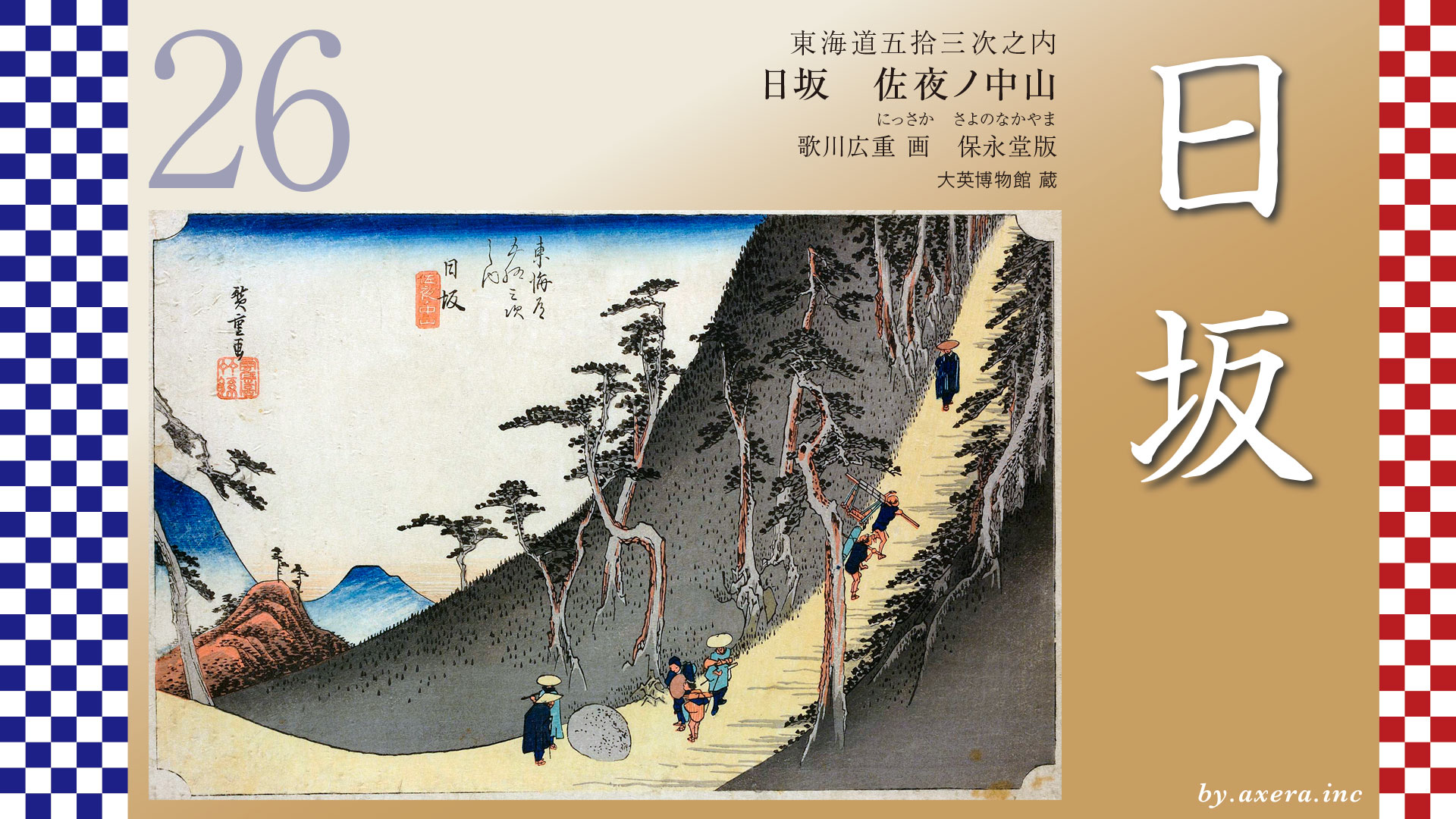
The Poem editin depicts the steep slope descending to Nissaka-juku. The sharply winding slope captures the actual terrain quite well.
I actually visited this spot. You can see how Hiroshige depicted the slope as quite steep. Nowadays, the trees on the left have grown tall, and you can’t see Mount Mungen anymore.
I placed Maruishi stone in this photo. It wasn’t an asphalt road back then, but it seems to have been right in the middle of this road.
Proceeding a little toward Nissaka-juku, Mount Mugen comes into view beyond the tea fields. It is the mountain visible behind the red transmission tower, and it is now called Mount Awagadake.
Please also view the Google Street View looking north. I’ve marked it in orange and added the Tokaido route.
The mountain in the background with the character “茶” (tea) appearing on its slope is Mt. Awagadake. Featured in both Reisho edition and Gyosho edition, this mountain lies just under 4 km north of the “Night-Weeping Stone”. At the time, it was famous for the “Bell of Mugen,” counted alongside the Night-Weeping Stone as one of the Seven Wonders of Enshu.
It was said that ringing the bell at Kannon Temple atop Mugen Mountain would bring immeasurable treasures in this life. However, it was also said that one would fall into the Avici Hell in the next life.
The rumor spread not only among the villagers but throughout Japan, drawing crowds of people who rushed to strike the bell, each eager to be first. Seeing this, the head priest of Kannonji Temple threw the bell into the ancient well in front of the temple and buried it, hoping to awaken people from their mindset that if things are good now, the next life doesn’t matter. Hiroshige truly provided some profoundly deep and thought-provoking prints in this series, didn’t he?
Please also view the Google Street View ahead. In the Meiji-era railway construction plans, it was deemed technically impossible to pass through Sayonakayama from Kanaya. Therefore, the line was connected from Kanaya through what is now Kikugawa City to Kakegawa. Consequently, Nisaka-juku became a quiet mountain town forgotten by the times.
After passing Yonakiishi, The Tokaido winds down a very narrow, steep mountain path, makes a wide right turn, passes through the quiet town of Nissaka-juku, and heads west toward Kakegawa-juku.
コメント