
Fifty-three Stages of the Tokaido
Goyu
Women detaining travellers
Hoeido edition, painting by Utagawa Hiroshige
The Art Institute of Chicago Museum Collection
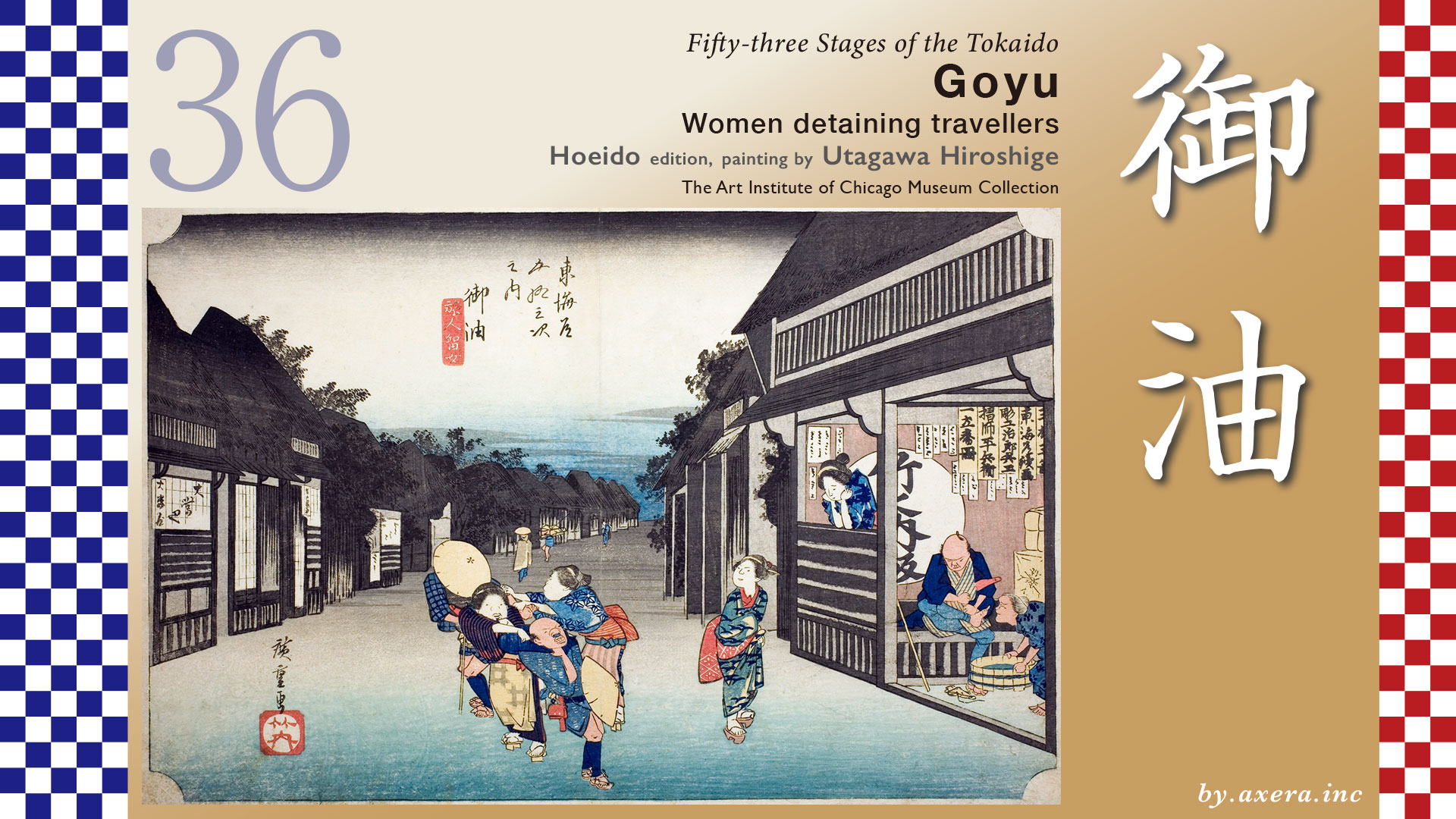
This is a humorous depiction of a traveler and a prostitute known as a “tome-onna” at the Goyu-juku at dusk.
The distance from Yoshida-juku to Goyu-juku was about 10 kilometers.
Crossing the Toyokawa River and continuing on for a while, you will cross the Toyokawa Diversion Channel, which did not exist during the Edo period. It was constructed in 1965 for flood control of the Toyokawa River.
A little further on, you’ll find the 57th milestone from Nihonbashi, Inona-Ichirizuka.
The Tokaido eventually merged with National Route 1 and turned left onto a small path at Yabushita in Kocho. Historical records indicate that during the Edo period, this area was merely a narrow path through farmland, essentially a simple dirt road.
The Tokaido eventually joins the Hime Kaido coming from the right, crosses the Otowa River, and enters Goyu-juku. In the Edo period, there was a amazake shop just beyond the bridge.
After passing through Goyu-juku, you come to the famous Goyu Pine Avenue. Pine avenues once lined various points along the Five Kaido, but Goyu’s is one of the few remaining. In summer, it provided shade from the sun; in winter, it served as a windbreak and snow barrier, protecting travelers. Additionally, the Edo-period comic book Tokaidochu Hizakurige depicts the story of Yajirobee and Kitahachi being tricked by a fox here.
A little further on, you’ll see a large camphor tree. This is the camphor tree of Sekikawa Shrine. Just before it lies Akiha Shrine, and beyond that lies Akasaka-juku.
Now, take a look at the Tokaido and Hime Kaido routes. After crossing the Tenryu River from Mitsuke-juku, most travelers proceeded along the Hime Kaido, circling north of Lake Hamana to reach Goyu-juku. That’s the green route.
The reasons were to avoid the strict Arai-sekisho checkpoint reached by boat from Maisaka, and to steer clear of the disaster-prone shores of Lake Hamana. Admittedly, the Tokaido route was considerably longer.
During the Tenpo era when Hiroshige painted this scene, it is said that the number of inns in this Goyu-juku post town exceeded 100. Why, then, did such a bustling post town become a scene of inns competing for customers? The answer lay in its relationship with the neighboring Akasaka-juku.
The distance between Akasaka-juku and Gozu-juku was a mere 1.7 kilometers, and the Tokaido and Hime-kaido had just merged right before them. At that time, aggressive solicitation by Gozu-juku was a common tactic to prevent the increased travelers from the merged roads just ahead from being taken by Akasaka-juku.
Please look at Hiroshige’s painting. The three towns of Yoshida, Goyu, and Akasaka were notorious for their aggressive hostesses. Women known as “tomeonna” or “ojare” would eagerly tug at travelers’ sleeves come evening, and it was said no traveler on the Tokaido could pass through these three towns without stopping.
Indeed, in Hiroshige’s print, the touts depicted as “tomeonna(women detaining travellers)” aren’t merely grabbing sleeves―they’re even reaching for luggage slung around travelers’ necks, with some depicted struggling under the weight.
However, the geisha-like woman in wooden clogs passing by merely glanced at them as if it were an everyday occurrence and was about to walk on.
Further to the right, a woman propped her cheek on her hand, seemingly unconcerned with the exchange, as if to say, “We’ve already caught him, so it’s fine.” The traveler from the inn on the right, who had actually been caught, was wiping his feet with a wash tub handed to him by the old woman.
The beauty of this painting lies in how the houses on the left are rendered in monochrome with rhythmic perspective, evoking the approaching night. Only the inn on the right is illuminated, its guests along the road depicted brightly.
Furthermore, within the round shoji window in the inn on the right, the publisher Hoeido’s shop name is depicted. To its right, a wooden tag lists not the names of the religious group members common in inns, but rather the names of the engravers and printers. At that time, printers and engravers were positioned at the very bottom of Edo’s artisan hierarchy. In particular, printers were often viewed as little more than gamblers carrying a single printing block. While it was common practice in ukiyo-e to include the artist’s name or publisher’s name as a playful touch, the names of carvers and printers had never appeared before. Among researchers, it is speculated that around this time, some kind of special reform or change occurred within the ukiyo-e production process.
The Reisho edition depicts Mount Fuji as seen from the area around Honnogahara, located beyond the Hime Kaido toward Edo, not from a relay station.
The Gyosho edition depicts a sweet amazake shop near where the Otowa River crosses into the Goyu-juku district. A red lantern from Toyokawa Inari hangs outside the shop.
The Poem edition depicts porters carrying goods marked with pictorial symbols as they cross the bridge over the Otowa River toward Yoshida. These pictorial symbols were clearly displayed when transporting goods belonging to the privileged classes, such as the shogunate and court nobles.
And Hokusai depicts the daily life of these “tomeonna”, the rice-serving women, with a touch of sensuality.
During the Edo period, the only officially sanctioned red-light district was Yoshiwara in Edo. The rice-serving women, however, were private prostitutes, semi-tolerated under the guise of being “servants at inns.” Edo regulations permitted each inn to employ up to two rice-serving women.
True to their name, rice-serving women performed duties similar to modern waitresses, serving guests. Yet, over time, the line between them and professional courtesans became increasingly blurred.
The travelogue “Tokaidochu Hizakurige,” a huge hit at the time, describes the Goyu-juku: “As night fell, women emerged from both sides, their faces painted as if wearing white masks, pulling at our sleeves. We were utterly appalled by their terrifying appearance and finally managed to shake them off.”
It seems Hiroshige took this description and turned it into a painting, depicting it as a scene of Goyu. Looking at it this way, it somehow makes sense.
I actually visited this place. While the houses look different now, they still retain traces of their former appearance. During the Edo period, as evening approached, over a hundred inns would send out Tomeonna women to call out to travelers.
This is the point where the Tokaido coming from the left turns toward Akasaka-juku, roughly the center of Goyu-juku. Goyu Station is located about 400 meters east of here.
After the Meiji Restoration, a district office was established in Goyu. However, since it was not selected as a stop on the Tokaido Main Line, its prosperity was overtaken by Gamagori after the railway opened. Later, when the Meitetsu Nagoya Main Line opened, a station was built here, but prosperity never returned. Today, Meitetsu Goyu Station is an unmanned station.
This is the Otowa River you cross before entering Goyu-juku. According to locals, the cherry blossom trees lining the river are said to be a very beautiful sight in spring.
This is Google Street View ahead, seen from above the old Goyu Bridge. Akasaka-juku, where travelers competed for lodging, lies just beyond the pine tree avenue.
コメント