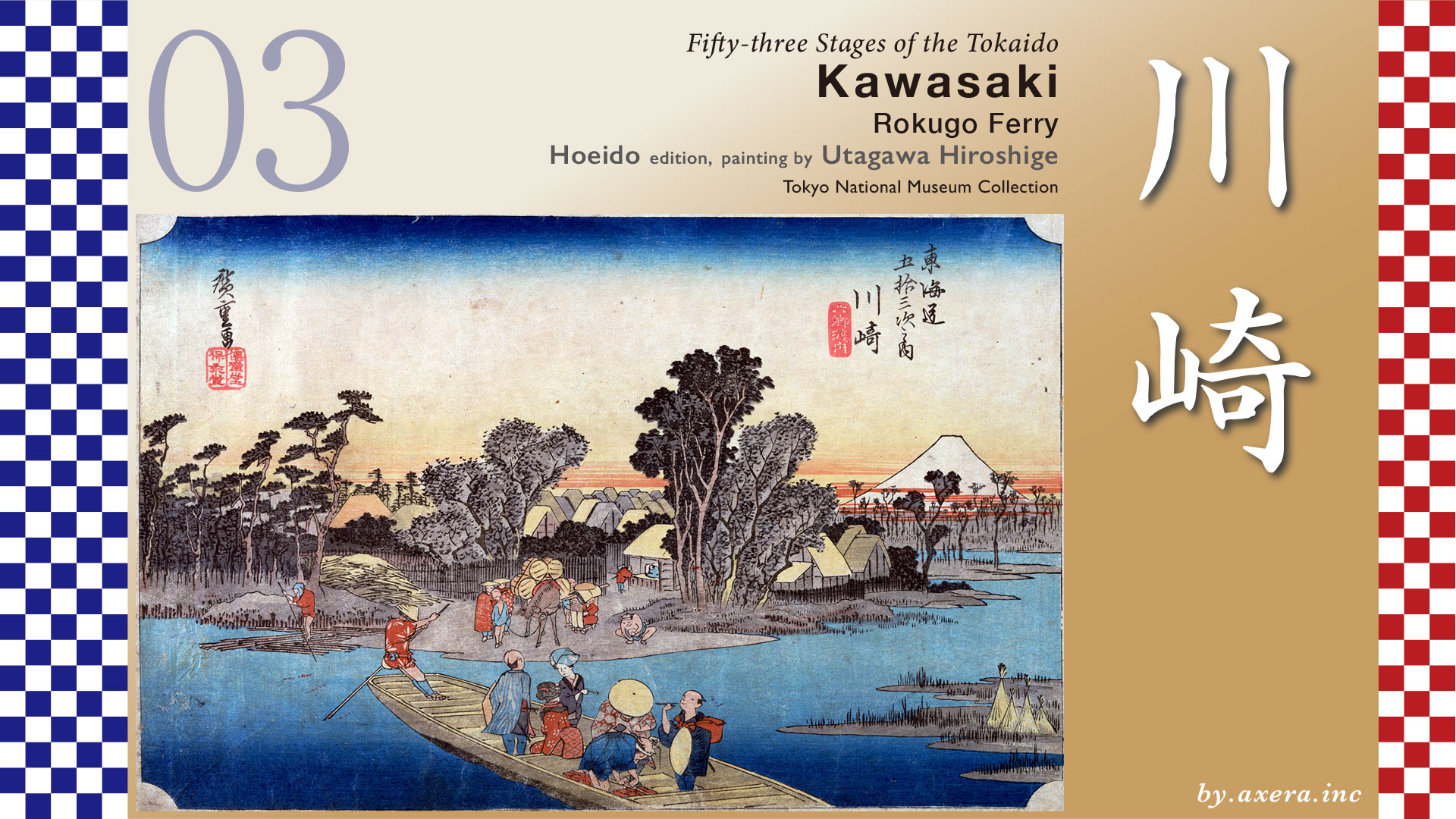
This picture shows the view from the north of the “Rokugo Ferry,” which was located near the present-day Rokugo Bridge on the Tama River. The distance from Shinagawa-juku to Kawasaki-juku was about 10 km, and it was necessary to cross the Tama River by boat on the way.
Today, the area around Shinagawa-juku on the Tokaido is a one-way road from north to south, with a shopping area on the north side and a residential area on the south side. Suzugamori is located where the road meets Daiichi Keihin road.
This is a picture of the Tokaido in this area, with a procession of feudal lords heading for Edo. You can see that the Tokaido is immediately flanked by the sea, which was covered with nori cracks.
Suzugamori is famous as a place of execution during the Edo period, along with Kozukappara in Senju, where as many as 100,000 to 200,000 criminals, including the famous Yaoya Oshichi, were executed over a period of 220 years. Travelers on the Tokaido at that time abhorred the Suzugamori execution site and mainly used another road, but it was not clear which course it was.
The cornerstones of the fire pit and crucifixion platform still remain, as if they were actually used. A temple for memorial services, called Daikyoji Temple, still stands just beside the temple.
It merges with Daiichi Keihin and immediately turns off to the left again around Heiwajima to become a narrow street. This road is called Mihara-dori by the locals, and even today it is a street that somehow reminds us of the Edo period.
Mihara Street merges with Daiichi Keihin again around the Omori Police Station, and after a short distance you will see Umeyashiki Station on the Keihin Kyuko Line running parallel to it on the right. The plum garden that gave this station its name is located a little further ahead on the right, and was called Kamata no Bai-en (plum garden in Kamata). Kyuzaburo Yamamoto, a merchant of a roadside medicine called Wachu San, collected famous plum trees and created a vast garden here, where he opened a tea house for travelers on the Tokaido.
Hiroshige selected and painted this plum garden in Kamata in his “One hundred Famous Views of Edo”. At that time, it was one of the most famous plum viewing spots in Edo, along with Kameido. Today, part of the garden has been preserved as Seiseki Kamata Umeyashiki Park.
The Tokaido passes the Nomigawa River and the Kanpachi road, continues with the Daiichi Keihin road for a while, and then hits the bank of the Tama River as it is.
When you go up this bank, you will see that grounds and other facilities were built on the riverbed of the Tama River. In those days, the river was narrower and there was a ferry a little east of the current Rokugo Bridge.
10
Immediately to the left across the Tama River was the Daishi-michi Road to Kawasaki Daishi.
To the right is the entrance to Kawasaki Inn. At that time, there was a tea store here called Mannenya, which was famous for its Nara chameshi, a well-balanced nutritious meal. Nara chameshi, rice with rice cooked with sencha green tea, was a welcome stopover for travelers at that time, and was served with miso soup made from shijimi clam caught in the Tama River.
The teahouse was also very popular with pilgrims to Kawasaki Daishi, and many of them stopped by on their way to visit the temple.
Now, let’s take a closer look at Hiroshige’s painting.
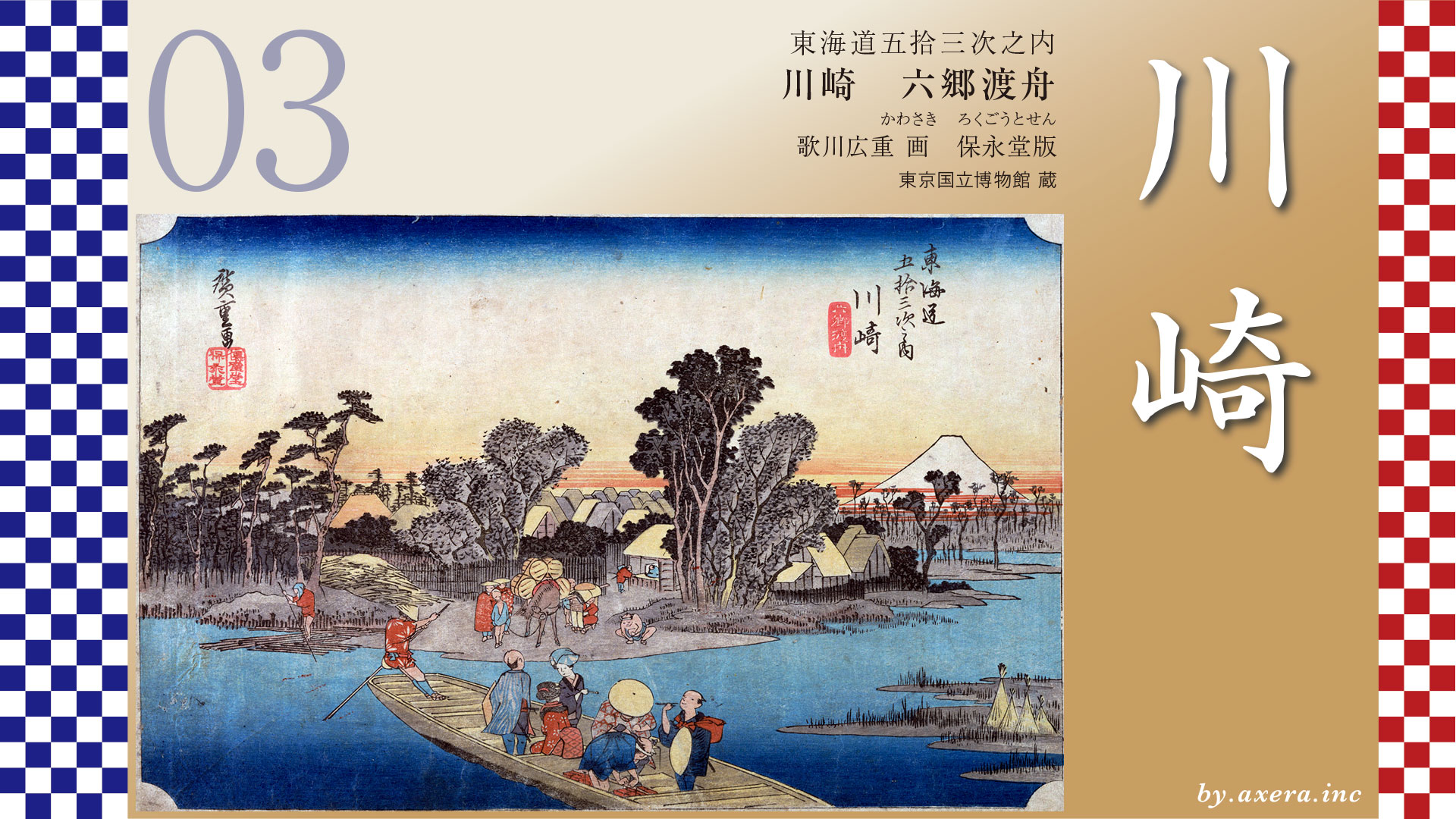
The Tama River at that time was called the Rokugo River in this area, and this painting depicts the ferry boat about to arrive at the Kawasaki side. The painting depicts a variety of people, including those who are getting ready to disembark and slowly puffing on their kiseru, those who are still packing their luggage, and a group of three samurai family members engaged in small talk, which is typical of Hiroshige. The boatman’s powerful pole handling is also superb.
On the other side of the river, horses loaded with rice bales await the arrival of the boats, passengers are riding in palanquins, and boatmen are picking up something. In the back is a hut for collecting boat fares, and in the distance to the right is the snow-capped Mt.Fuji. As a matter of course, the river in those days was used as it flowed without building a high embankment, and bamboo fence were used around point of arrival for ferries.
There is an other version in this painting.
The outline of Mt. Fuji has disappeared, the boatman’s clothing and posture have changed, and the angle of the slope of the roof of the house and the way it is painted have changed. The left side of the painting is also completely different, and the stamp for the subtitle is no longer in white letters.
The Reisho edition is a painting of two ferryboats passing each other, viewed straight ahead from downstream. The Bensai boat that travels up and down the Tama River, is also depicted from the front. It is clear that the Tama River was also used as a logistics transportation route.
The Gyosho edition depicts mainly boats passing each other from the Rokugo side, with a large image of Mt. Fuji in the distance. The two boats are lined up with passengers, weaving hats and umbrellas, so it must have been a midsummer scene. Fuji was probably clearly visible from the direction of the boat.
The Poem edition looks a little downstream from the Rokugo side boarding area and depicts rafts as well as moored boats on the river. Anticipating the demand for lumber in Edo, where fires were frequent, the transportation of lumber from the Ome area seems to have been a major industry.
I actually went here. This is a shot taken from the bank of the Tama River cycling path in the direction of the Rokugo ferry. Compared to the Edo period, the river is different in width and the exact location of the ferry is no longer known.
19
As usual, heavy machinery was in the riverbank doing construction work, so we could not go to the side of the river that day.
This is a photo of the site from a book published in 1918. In fact, the owner of a long-established Japanese sweets shop at Rokugodote Station testified that even at the beginning of the Showa period, the river was much narrower and the banks were much closer to the river.
This is a picture of the Rokugo direction seen from the Kawasaki side. The Rokugo Bridge, which is now a large bridge, was the ferry between Hachimanzuka Village and Kawasaki relay station on the Tokaido, and was extremely important in terms of transportation as the ferry at the entrance to Edo. In the early Edo period, the Rokugo Bridge was built by Ieyasu Tokugawa, but it was washed away by a flood in 1688, and no bridge was built here thereafter until 1874.
This is a Google MAP of the Tama River during construction, viewed from a little higher up, assuming the Rokugo ferry.
The management of the ferry was initially undertaken by the townspeople of Edo, but from 1709, the head of Tanaka Honjin approached the Shogunate and the Kawasaki juku took over the management of the ferry, and the income from this ferry supported the finances of the Kawasaki juku to a large extent.
I drew Tokaido and Rokugo ferry on Google MAP from a little higher up.
The shukueki-denma system imposed on relay stations was that official travelers and goods were transported to the next relay station free of charge. The Rokugo ferry was literally a boon for Kawasaki relay station, which suffered from the heavy traffic.
When Kawasaki was at its most prosperous, there were three Honjin, but after the mid-Edo period, the number of visitors eased and the financial difficulties of the feudal lords, as well as famine and natural disasters, caused the relay station to once again lose its vitality, one of the Honjin was closed, and Kawasaki as a relay station became deserted.
There is also a story that Harris, the U.S. Consul General to Japan, changed his lodging to Mannenya when he saw the shabbiness of the Tanaka Honjin where he planned to stay. When this picture was painted, Kawasaki juku was about 1.4 km long from the edge of the Tama River, with about 500 houses and a population of about 2,500.
Looking at Hiroshige’s painting again, we can see that the village in the background was already a row of houses in Kawasaki juku. A little further ahead, on the left, there is Mannenya, where you might have met the very popular specialty, Nara Chameshi.
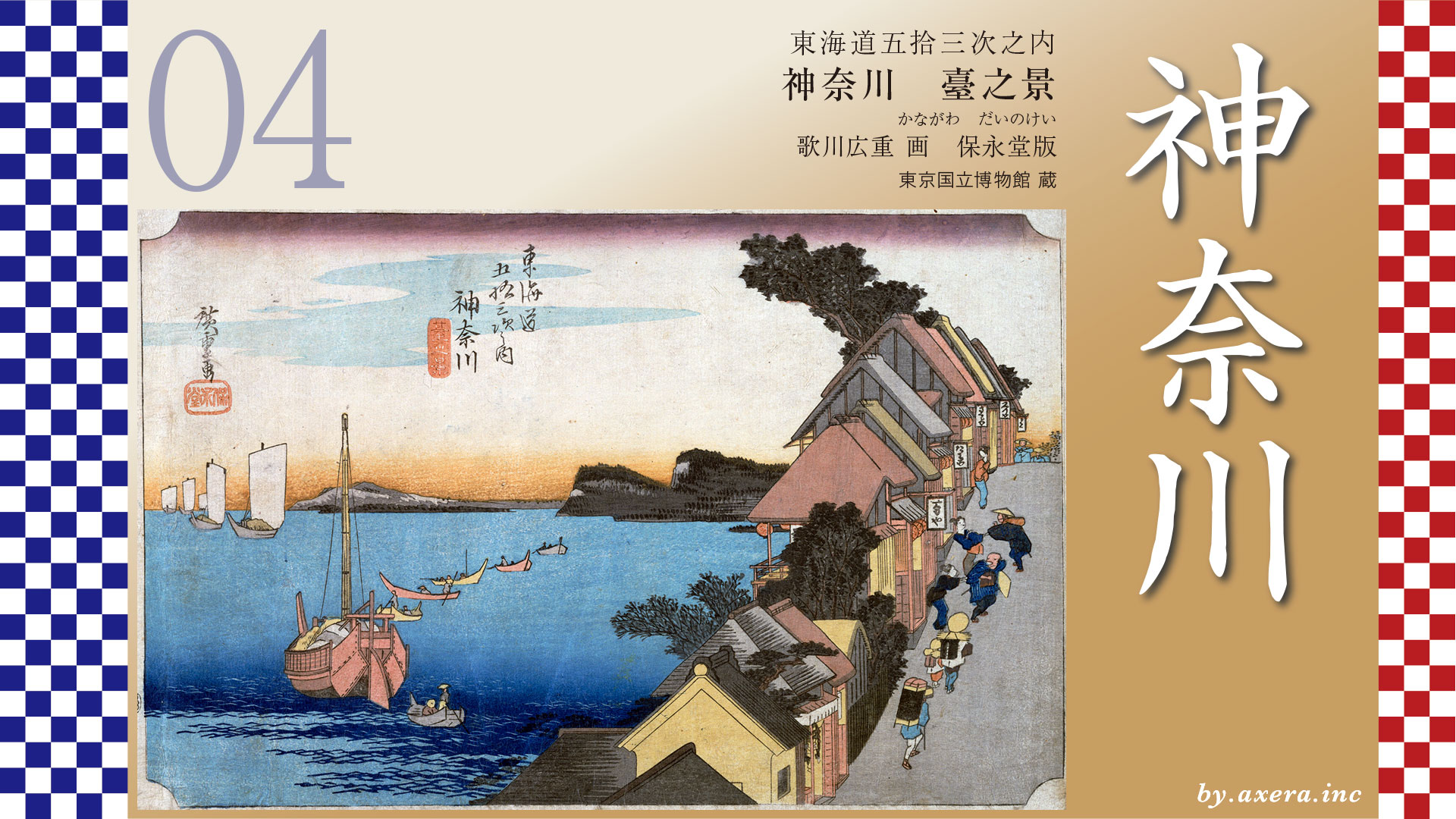
The Tokaido, which crosses the Tama River by boat, heads for Kanagawa-juku after passing Kawasaki-juku.
コメント