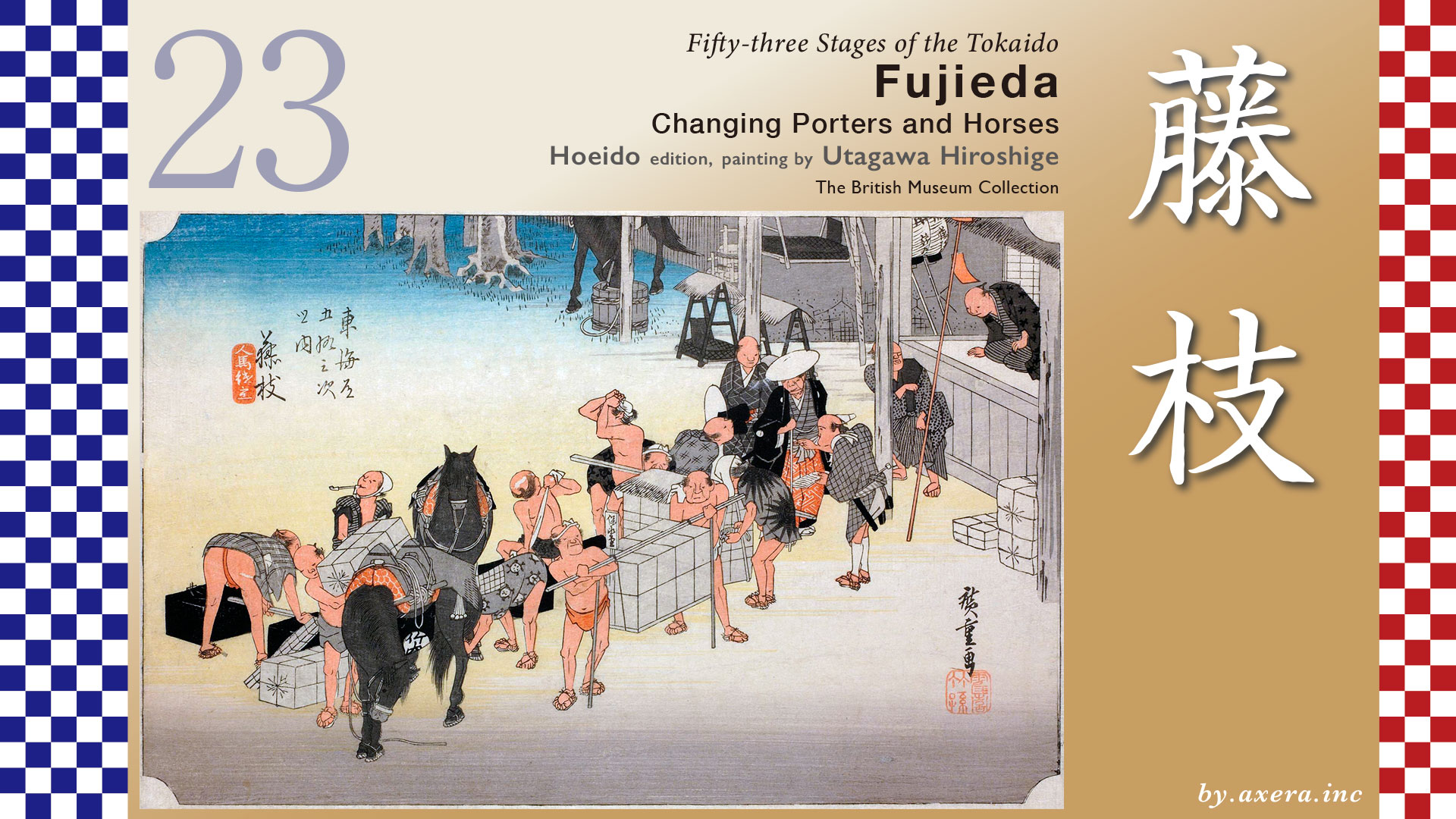
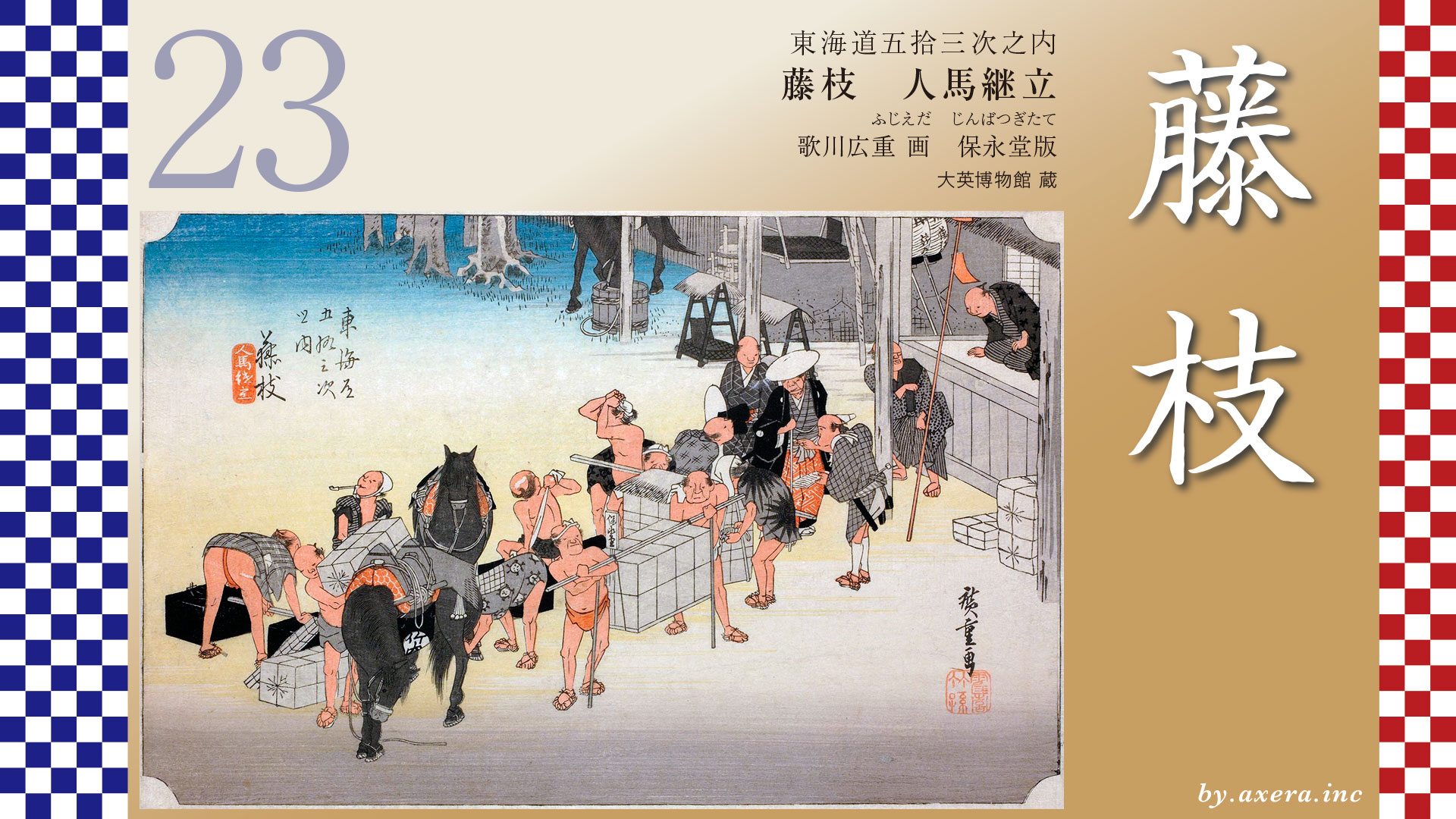
This painting depicts the scene of luggage handover at the Toiyaba (Transfer offices) in Fujieda-juku.
From Okabe-juku to Fujieda-juku, the journey is approximately 7.9 km to the south-southwest.
Okabe-juku begins at Kashibaya, a large inn now registered as a national tangible cultural property. Across the street from this inn was the Honjin of Okabe-juku during the Edo period.
Passing through the Toiyaba and Kousatsuba area and further south, you will now pass under the Fujieda Bypass on Route 1. Just before that is the western end of Okabe-juku, or Kyokata-mitsuke. There is also a rather artistic stone pillar here.
The Tokaido crosses a small river twice from here, passing through Ichirizuka in Onijima before reaching Tateba in Onijima. Tateba is a place where travelers can take a rest. At that time, Tanaka Castle was visible in front of the stand.
From here, the road becomes cranked, as in a castle town, and although The Tokaido is partially divided due to road widening, it eventually joins a street called Sawayaka-dori. A little further on, you will see a sign for Fujieda Narita-san on the right. Across from it is the eastern end of Fujieda-juku, where it began. At that time, this was the Oiwake, and turning left would take you to the Yaizu Port.
Enlarge the map.
The Tokaido, from Sawayaka-dori to Kamidenma-dori, which turns gently to the left, changing its name to Shirako-dori, Chorakuji-dori, and Chitose-dori, had two Honjins on the right side. Just beyond them were the Toiyaba that Hiroshige had painted.
The Tokaido was crossed by a bridge over the Seto River, which at that time was a river handing over of the human power, and Shida Ichirizuka was located just beyond the bridge.
Please enjoy the feeling of traveling from the Edo-mitsuke area to the Setogawa River on the map created by the Edo Shogunate’s road magistrate at that time.
The “Toiyaba” mentioned here was a place where people and horses, as well as luggage, were taken over at inns along the highways in the Edo period under the “denma”, and horses and manpower were provided for this purpose. As the volume of logistics increased, Toiyaba were also important places that played a key role in the development of relay stations.
In addition, Toiyaba, called sukego, were places that even managed human resources for labor in lieu of taxes, and the person who presided over the business was called a Toiyaba. The manager was called “Toiya.” In addition, there was an assistant to the Toiyaba, a bookkeeper who entered information on the comings and goings of people and horses, as well as their wages, and a horseman who distributed the goods to the people and horses.
Therefore, unlike today’s “tonyasan(wholesaler),” which is a middleman in the distribution industry, a Toiya was a merchant who acted as an intermediary between people and horses.
Based on these, let’s take a closer look at Hiroshige’s painting and enjoy the movement of people and horses in Toiyaba of the time.
The person sitting at the far right and talking with the people at the side is an juku official. He is either a toiya or his assistant. The floor of the building is slightly elevated so that he can do paperwork while riding his horse. The warrior in the woven hat and haori on the left is the owner of the cargo, who is checking the assignment of the horses and the condition of the cargo with the bookkeeper on the right and the horseman on the left. It seems as if you can hear them talking to each other.
The duo in the front in the middle are holding a walking stick, just lifting their luggage, and saying to each other, “Well, it’s time to go. The two in the back are wiping the sweat from their backs and tightening their hachimaki, so I guess they have finished their work, put down their luggage, and are taking a short break while saying “kandariidaraa (I’m tired)”. I am not familiar with Shizuoka dialect, so I am not sure if I am right or not.
The man-at-arms between the two horses is checking the condition of the sandals on the horses, isn’t he? The man-at-arms on the left is trying to put his baggage on the horse. I wonder if the horse is all right.
The person on the far left has put down the black box and is about to take a rest. The man on the right, with a smoking pipe in his mouth, looks as if he is worried about the weather.
In the center of the painting, there is a horse with its face in a horse trough, two empty palanquins on the right, a slightly collapsed clay wall on the right, and two imperial lanterns hanging there.
The Reisho edition depicts Tanaka Castle over a row of pine trees just before entering Fujieda-juku. Travelers, farmers, and palanquin-walkers on their way back in the dim rain are depicted.
The Gyosho edition depicts a ferry crossing on the Setogawa River. You can see that the Setogawa is not a big river, but a little small river.
Poem editin also depicts a crossing of the Setogawa River. On the right side, there is a simple bridge, which is temporarily built in winter when the water volume is low. If you look closely, you can see that the bridge is stopped on the other side of the river.
I actually went here. This place is now the Kamidemba police box and parking lot. Beside it, this painting by Hiroshige is prominently displayed. In the Edo period, many people passed through here, and many baggages, horses, and people must have come and gone.
Please take a look at the GoogleMAP street view. This is a view looking south from the Toiyaba in Kamidenmacho that Hiroshige painted. The Tokaido in orange is also depicted.
The fact that Hiroshige painted this wholesale store scene in Fujieda suggests that he paid considerable respect to the distribution system of the time. In the Edo period, settlements, especially castle towns, set up Toiyaba for development, which eventually became the center of the town and were named “denmacho” . So, an “juku” was not just a settlement with a cluster of inns, but also a station where people and goods were circulated.
Please also take a look at a more extensive Google MAP street view. The area in front of the Seto River was the center of Fujieda until the Edo period, but nowadays the area around JR Fujieda Station looks more crowded with tall buildings and the like. Are the times changing?
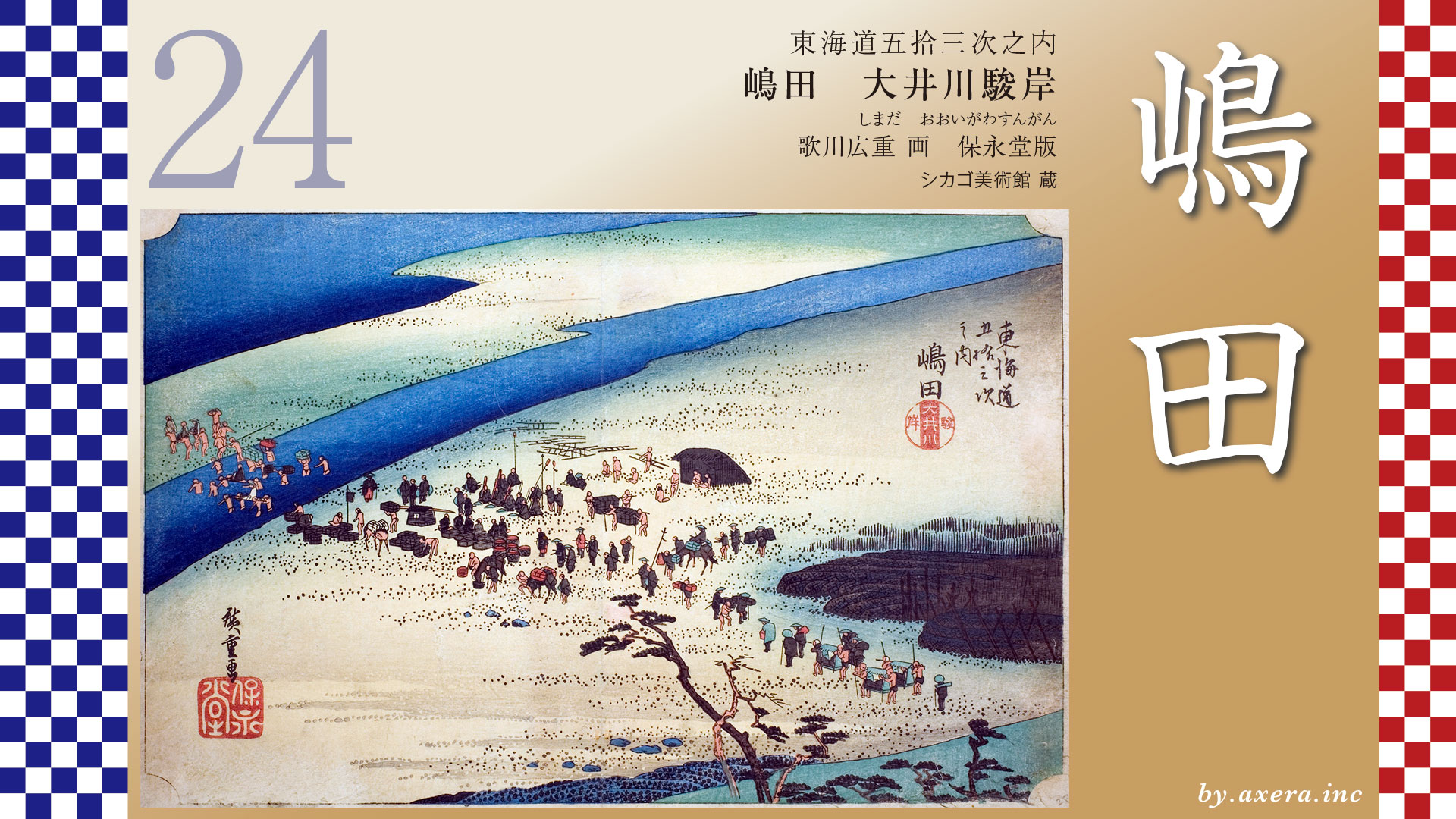
The Tokaido crosses the Seto River and heads for Shimada, 8 kilometers away, and the Oigawa River.
コメント