
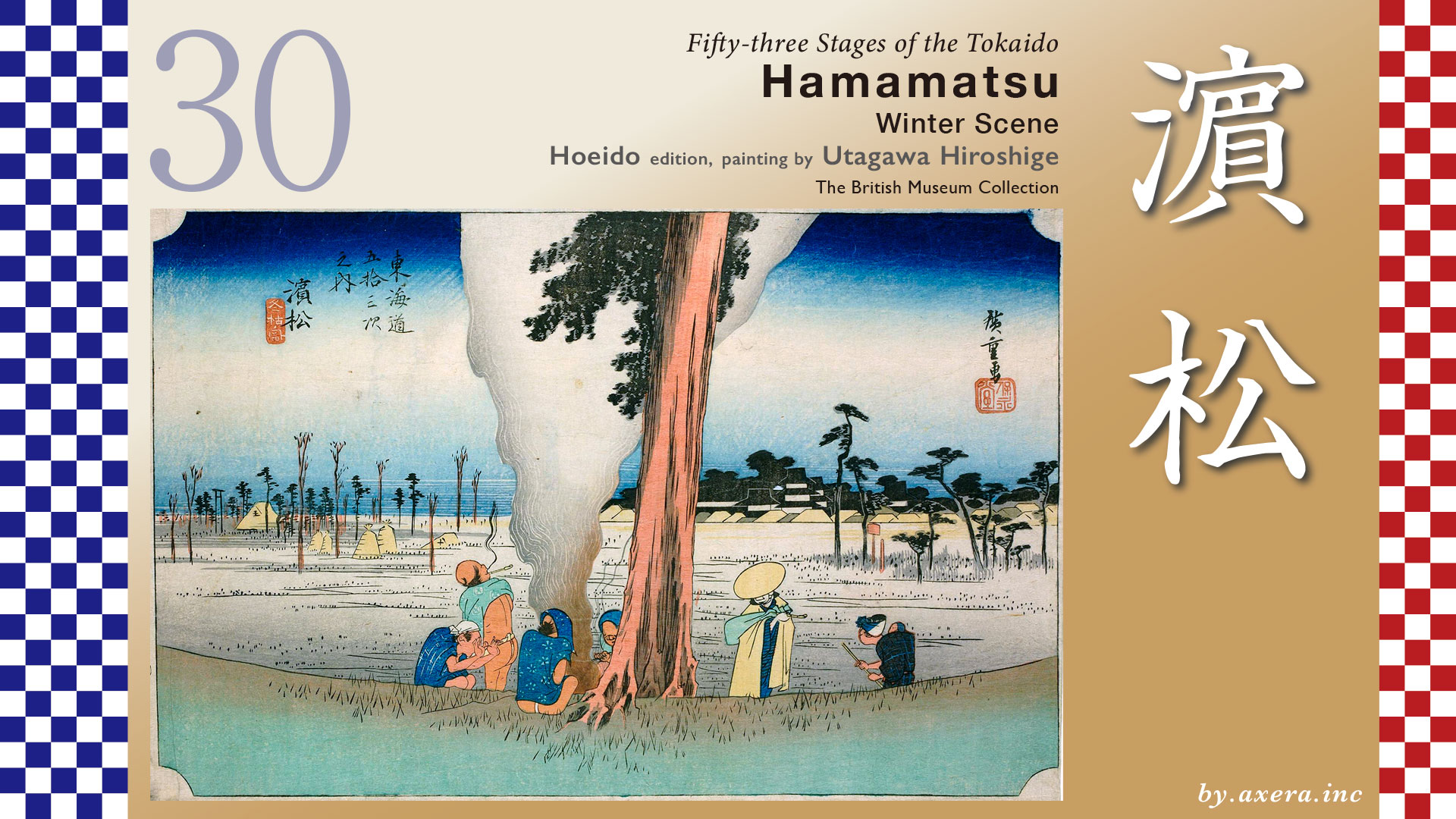
his painting depicts Hamamatsu Castle seen from the Tokaido road, across a teahouse and rice fields after harvest.
The distance from Mitsuke-juku to Hamamatsu-juku is about 16 km, but the distance along the banks of the Tenryu River is less than half that, just under 8 km.
The Tokaido crosses the Tenryu River, heads west through Nakanomachi Village, and soon reaches the fork with the Himekaido. Though now just a narrow alley, turning right here once led north toward Lake Hamana and the Kiga area along the Himekaido.
A little further on lay the Magome milestone, and crossing the Magome River brought one to Hamamatsu-juku.
Upon entering Hamamatsu-juku, the Tokaido made a sharp left turn at Renjaku-cho, where Hamamatsu Castle came into view, heading toward the coast. Continuing straight through Renjaku-cho would have taken travelers north past the west side of Hamamatsu Castle, allowing them to follow the Himekaido north along Lake Hamana.
Here, to see the Himekaido, please take a closer look at this enlarged “Rekichizu” detailing the route at that time. It is said that back then, many travelers used the Himekaido, which bypassed Lake Hamana and headed west from the north, rather than the Tokaido.
Please check the reason on a map that’s a bit easier to understand. It shows the navy blue Tokaido and the green Himekaido drawn on Google Maps.
The Himekaido offered a shortcut through the northern part of Lake Hamana to reach Goyu. It also avoided the strict checkpoint at Arai barrier, famously described as “Enter the gun and leave the woman,” making it a popular route for women and earning it the name Himekaido.
“Enter the gun and leave the woman,” refers to the strict regulations imposed by the Edo shogunate to prevent rebellion. These regulations targeted “firearms and other weapons entering Edo” and “daimyo wives and women leaving Edo” at checkpoints. The purpose was to prevent uprisings caused by smuggled weapons and to prevent the escape of daimyo wives and women, who served as hostages.
The Tokaido road heading south passes through Hamamatsu-juku, goes under the Tokaido Line and Shinkansen, and eventually turns westward, reaching the vicinity of JR Takatsuka Station. Near the coast in this area stands Rokusho Shrine, and in front of its gate, the second-generation Otowa Pine now grows. This Otowa Pine is closely related to Hiroshige’s painting, “Winter Scene.”
Let’s take a closer look at that “Winter Scene.”
The villagers gathered around a solitary cedar tree depict an everyday scene: each warming themselves freely, some puffing on pipes, others leaning back. The traveler in a raincoat and woven hat, gazing slightly resentfully at the source of the billowing smoke, adds a nice touch. To his right, a woman in a nanny’s attire gathers dead branches. This must have been a common winter scene around here, I suppose.
In the background, harvested rice fields stretch out, and to the left, beyond stacks of rice straw, a building is depicted. The small torii gate suggests this is likely Hamamatsu Hachiman Shrine. To the right, several pine trees are drawn, and the presence of a signboard indicates this is probably the famous “Zazanza Pine.” Farthest in the background, Hamamatsu Castle and the Hamamatsu-juku are also depicted, albeit small.
This is a second edition, but despite being described as winter-bare, the lower part of the painting shows vivid green hues, and the forest of Hachiman Shrine appears dark. However, corrections are also visible, such as windows being added to Hamamatsu Castle and the roof being clearly color-separated.
Looking at it this way, it seems the first printing was made using woodblocks prepared differently from Hiroshige’s printing specifications.
Hiroshige depicts “Zazanza-Pine” in his Reisho edition. Two local villagers pass by, while a slightly mysterious monk gazes out at the distant sea, alongside two large pine trees.
This “Zazanza Pine” is said to have originated from a pine tree at Kobe Shrine in Kozawatari-cho, Minami Ward. This area is near the coast of the present-day JR Takatsuka Station.
The pine at Kobe Shrine was initially called the “Otowa Pine.” By the Edo period, its branches and foliage had grown so large it became a massive tree, about 36 meters tall. It is said ships navigating the distant Sea of Enshu to the south used it as a landmark visible from the sea. However, the tree began to decline around the end of the Edo period and had withered away by around 1877. Today, the second-generation “Otowa Pine” stands planted at the entrance to Kozawata-cho, near Rokusho Shrine.
Hiroshige also depicts the “Zazanza Pine” alongside a traveler in his Gyosho edition. Seeing the traveler gaze intently at the pine with such interest, it seems this pine was well-known throughout the land.
The “Zazanza Pine” is said to have earned its name when Ashikaga Yoshinori, the sixth shogun of the Muromachi period, stopped in this area in 1432 to view Mount Fuji. He held a banquet beneath this pine tree and sang, “The sound of Hamamatsu is zazanza,” leading to the tree being called the “Zazanza Pine” ever since.
It is also said that Tokugawa Ieyasu renamed Hikuma Castle, located in what was then Hikuma Village, to Hamamatsu Castle, establishing the basis for the present-day place name Hamamatsu, because this pine tree stood on the beach.
The satirical verse depicts the scene at Hamamatsu Castle and Hamamatsu-juku along the Tokaido.
Katsushika Hokusai’s Tokaido: Hamamatsu also depicts the “Zazanza Pine,” but compared to the travelers and tea houses, this pine must have been a remarkably large tree. Moreover, the fact that Hokusai chose to paint it suggests this pine was a symbolic presence in the area.
This is the current Hamamatsu Hachimangu Shrine.
There is another legend about the “Zazanza Pine.” In 938, when Kobe Shrine, where the “Otowa Pine” once stood, was relocated to its present site as Hamamatsu Hachimangu shrine, it is said that a white fox arrived carrying a pine sapling. The pine planted here grew magnificently and came to be called the “Zazanza Pine.”
This “Zazanza Pine” stood in a place called Noguchi Village Forest, about a hundred meters east of Hachimangu Shrine. At that time, about thirty pine trees grew in a grove here, and even by the Taisho era, fifteen to sixteen remained. However, they were all burned in the air raids of 1945, and subsequently, pines were replanted within the grounds of Hachimangu Shrine.
The “Zazanza Pine” depicted in Hiroshige’s “Winter Scene” appears to be the pine tree that once stood in this Noguchi Village forest.
I searched for a location that meets the depicted conditions. First, please look at the map.
I sought a spot where Hamamatsu Hachimangu Shrine is on the left, the “Zazanza Pine” in Noguchi Forest is on the right, and Hamamatsu-juku and the castle are visible between them. However, no such location exists along the Tokaido. Furthermore, attempting to meet these conditions would require straying significantly north of the Tokaido route.
Therefore, I marked the approximate location I believe to be Hiroshige’s viewpoint with a red gradient.
I actually visited this spot. After crossing the Magome River along the Tokaido Road, I turned right, headed north, and took this shot looking toward Hamamatsu Castle from around Noguchi-cho. It seems this “Winter Scene” is a painting born from Hiroshige’s original image vision.
Therefore, rather than focusing on Hiroshige’s specific viewpoint, it appears he depicted the famous “Zazanza Pine,” Hachimangu Shrine, Hamamatsu Castle, and the daily life of villagers at that time, thus creating the “Winter Scene.”
Please also view the Google Street View ahead. I’ve colored the Tokaido orange and added what I believe to be Hiroshige’s viewpoint. The Tokaido curves south from Hamamatsu Castle toward the sea, then heads west along the coast toward Maisaka-juku. Beyond Hamamatsu Castle lies Lake Sanaru, and beyond that, Lake Hamana finally comes into view.
コメント