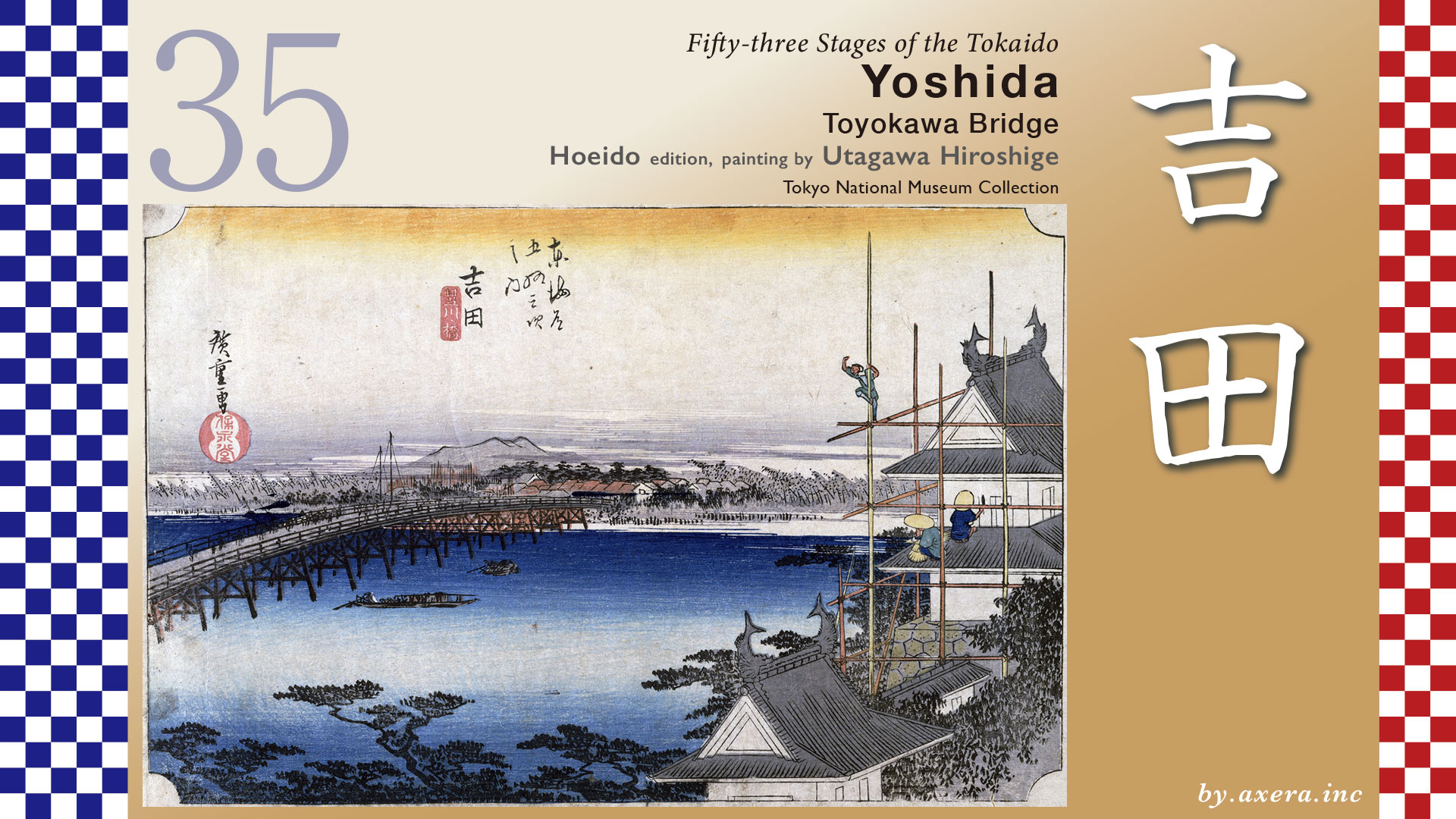
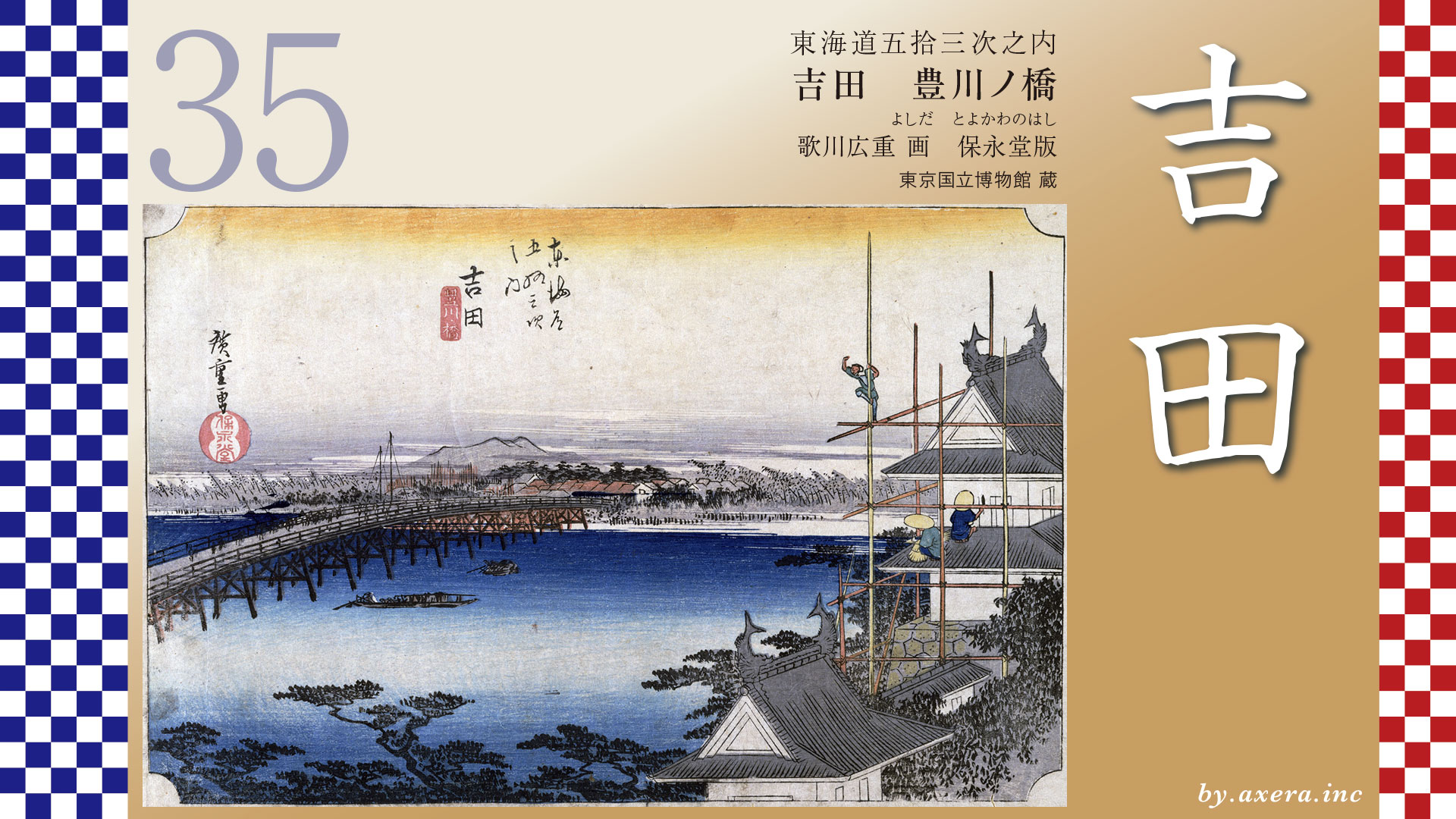
This is a painting depicting the large bridge spanning the Toyokawa River, visible beyond Yoshida Castle―a sight known to everyone during the Edo period.
The distance from Futagawa-juku to Yoshida-juku is approximately 5.9 km. Yoshida-juku is present-day Toyohashi.
Leaving Futagawa-juku, the Tokaido passes through what is now JR Futagawa Station, crosses the Tateiwa Kaido, and climbs up Hiuchi-zaka.
Climbing the slope and circling around Iwaya Kannon, in the Edo period a row of pine trees would soon come into view, but now only a single pine tree remains, known as the Remnant Pine.
Crossing the Yagyu River leads to the junction with National Route 1, and that junction was the Iimura Ichirizuka milestone.
From the Higashi-Hachicho intersection, the East Somon Gate stands as a hallmark of the castle town, with the road winding narrowly along the gate. From here begins Yoshida-juku.
The Tokaido passes through the western gate of Yoshida-juku at its western end, and after two turns, it reaches the Toyokawa River. Today, the “Toyobashi” bridge stands here, but the bridge depicted by Hiroshige in the Edo period was located slightly downstream from this spot.
The bridge depicted in Hiroshige’s painting was not the Yoshida Ohashi spanning just beside the present castle, but rather one located about 200 meters downstream from the current “Toyobashi.” This bridge was not called “Toyokawa no Hashi” at the time, but rather Toyokawa Bridge or Yoshida Bridge. It was an enormous bridge, approximately about 220 meters long, managed by the shogunate, and counted among the Three Great Famous Bridges of the Tokaido.
Let’s overlay a map from 1907. Where the Yoshida Ohashi Bridge stands today, there was no bridge, but rather “Sekiya’s Boat Landing.” The Yoshida Ohashi Bridge was built in 1959.
In 1580, when Ikeda Terumasa was lord of the castle, the Toyokawa River was called the Imahashi River, and Yoshida Castle was also known as Imahashi Castle. It was this Ikeda Terumasa who replaced the earthen bridge originally spanning the Imahashi River with a wooden bridge, naming it the Yoshida Ohashi Bridge.
During the Edo period, the Tokaido was developed, and the bridge Hiroshige depicted with the subtitle “Toyokawa Bridge” is this Yoshida Ohashi. I’ve added Hiroshige’s viewpoint using a red gradient.
During the Meiji period, the bridge was rebuilt slightly upstream and renamed “Toyohashi.” It’s orange, isn’t it?
Furthermore, after the Showa era began, the current Yoshida Ohashi Bridge was built at “Sekiya Boat Landing” right beside the castle. However, to distinguish the city’s name from the bridge’s name this time, the orange-colored bridge name came to be called Toyobashi.
The evolution of this rather complicated name is quite intricate, but Toyohashi subsequently developed significantly as the castle town of the Yoshida domain, as a port town that prospered through shipping on the Toyokawa River, and ultimately as a major station for the Shinkansen bullet train.
Now, let’s take a closer look at Hiroshige’s painting. On the right is Yoshida Castle, and on the left is Toyokawa Bridge.
A daimyo procession is currently crossing that bridge, depicted with numerous people crowded together like ants. Two boats are shown on the river, and three large landing stages were located near the shore. One of these stages offered direct boats to Ise, and it seems many travelers took the sea route from here to journey to Ise. In reality, the Toyokawa River meandered a bit more than depicted here.
Yoshida Castle is depicted under construction in the painting, showing craftsmen applying plaster to the walls. One of these craftsmen has climbed to the top of the scaffolding and appears moved by the distant view. Hiroshige’s treatment of this area is quite interesting. At the time this painting was created, Yoshida Castle was the residence of Matsudaira Izuno-kami, a daimyo with a fief of 70,000 koku.
Yoshida-juku served as a post station combining the castle town with the ship district of Yoshida Port. It featured a wharf for changing horses and riders, two honjins , one wakihonjin, 65 lodgings, and a population of around 7,000 people.
The Reisho edition depicts the Tenno Festival at Yoshida Shrine within the castle grounds. Kagura dances were performed as a prelude to the mikoshi procession, serving to drive away evil spirits. Standing fireworks were set off during the eve festival, and it is said these may have been the prototype for the handheld tube fireworks widely practiced in this region.
The Gyosho edition depicts Yoshida Castle as seen from Yoshida Bridge, but the castle did not appear this close. Furthermore, the mountain depicted behind the castle is thought to be Mount Ishimaki, about 360 meters high and part of the Yumihari Mountains. However, it did not appear this close or large; it should have been cut off further to the left.
The Poem edition depicts Yoshida Bridge, Yoshida Castle, and the Toyokawa River. It vividly conveys the bustling activity of Yoshida Port, a vital hub for people and goods. At one time, a significant number of travelers used pilgrimage boats from Yoshida Funamachi port to reach Ise. Records show that in 1797, requests to halt these pilgrimage boats were made by Miya-juku and Saya-juku, inns associated with the Shichiri no Watashi and Sanri no Watashi ferry crossings. However, these requests were rejected by the Council of Elders.
Also, while the bridge and castle are still too close together, the mountain depicted behind the castle in the Gyoso edition had not yet appeared at this point.
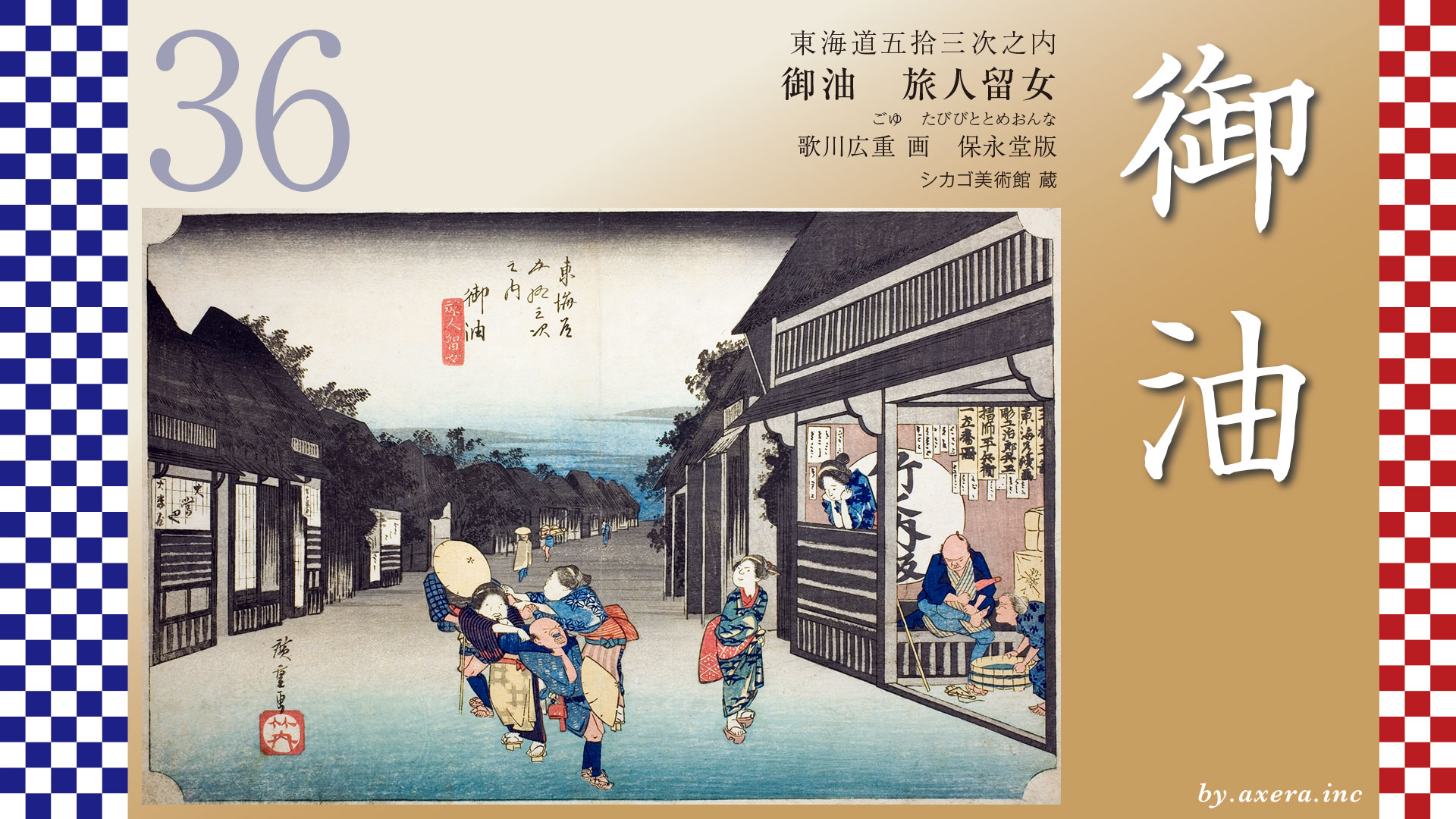
Hokusai’s Fifty-Three Stations depicts the famous fire starters and the Okame mask. Fire starters were essential items at the time, used to transfer sparks from flint to kindling. In Yoshida-juku, there were about six fire starter shops, including this Ebiya, making them a local specialty.
The Okame masks, meanwhile, seem to represent the numerous private prostitutes known as “rice-serving women.” Popular folk songs of the time widely circulated lines like, “Passing through Yoshida, she beckons from the second floor, dressed in a deer-spot patterned furisode kimono.” This “deer-spot” pattern was a pun on the strong reproductive power of deer, symbolizing the wish for prosperous offspring.
I actually visited this place. While you can’t climb the castle now, the closest view to the one Hiroshige painted is this one from the observation deck of Toyohashi City Hall. The distant bridge is the current Toyohashi Bridge, while the bridge Hiroshige depicted was a bit further downstream.
I also checked out Google Street View. While the viewpoint is a bit too high, this is probably what the view from the castle looked like.
I edited this photo slightly to remove Yoshida Ohashi Bridge and moved “Toyobashi” a bit downstream to the location of the Toyokawa Bridge at that time. Looking at it this way, you can see that Yoshida Castle and the “Toyokawa Bridge” depicted by Hiroshige were quite far apart.
Though the angle differs slightly, I’ll include Yoshida Castle as well. Hiroshige, who misunderstood this distance to the bridge, apparently hadn’t actually seen Yoshida-juku either.
Now, using Google Street View, I’ve looked ahead from the current location above “Toyobashi” and highlighted the Tokaido Road in orange. After crossing the Toyokawa River, the Tokaido Road heads toward Goyu, not Gamagori.
Incidentally, this very first bridge, which has come to be called “Toyobashi,” is apparently registered as “Toyohashi” in Ministry of Land, Infrastructure, Transport and Tourism documents.
コメント